


Issue 005 · October 2026
The reading problem
You have had this meeting. You said the thing you meant. It arrived as something else.
The announcement was generous. The team heard abandonment. The dashboard was green. The person you most needed to hear from had gone quiet.
I spent the past month following four leadership decisions inside an AI redesign: what a role actually holds, who really gets access to the new tools, how a team grieves the old way of working, and what a leader owes the person going quiet. Laid side by side, they turned out to be one decision seen from four angles. Each time, a leader acted on a readable stand-in for something that could not be read directly. A role instead of a person. An announcement instead of access. A stage model instead of grief. A dashboard instead of a face.
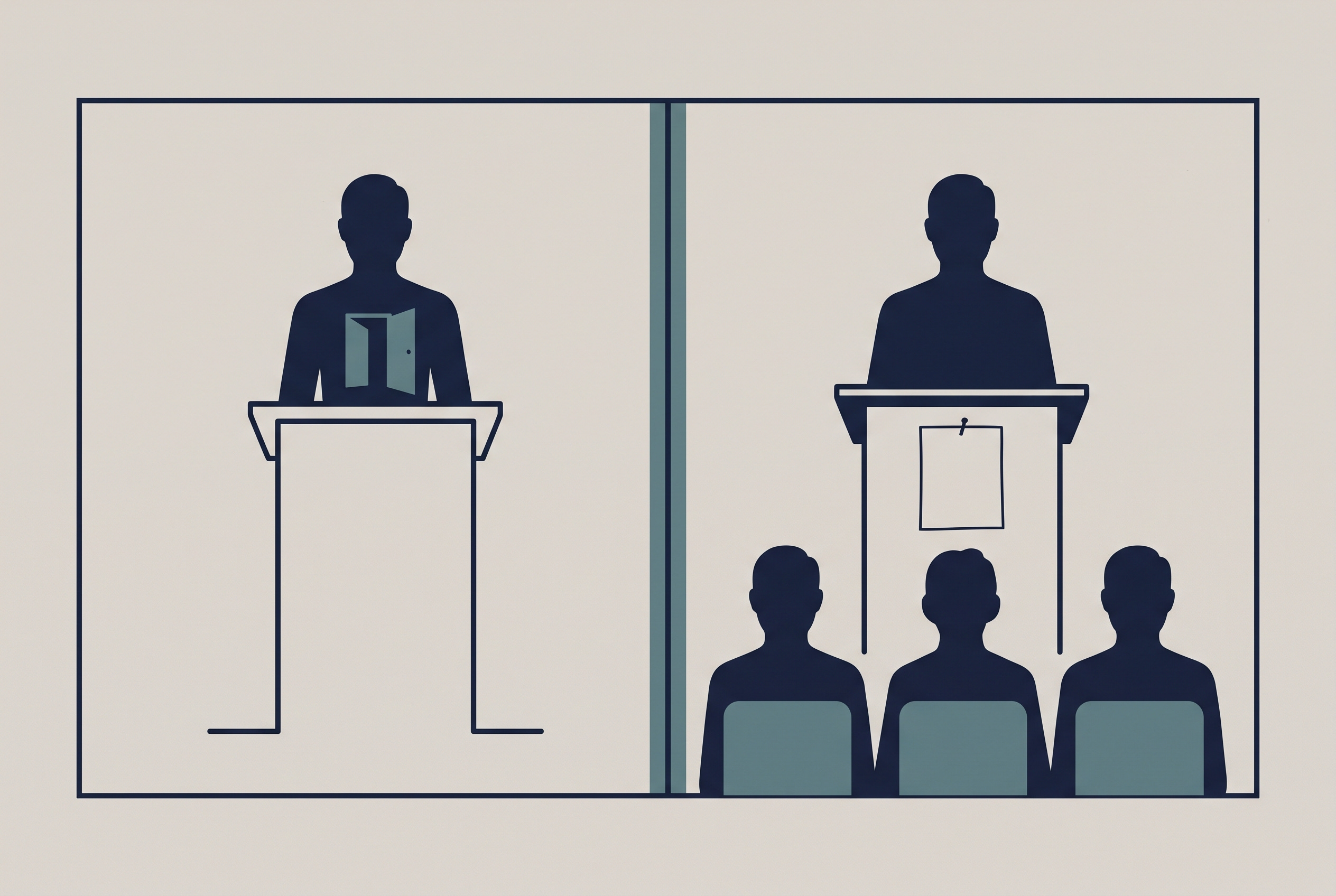
Every leader manages a surface and stands on ground the surface cannot show. This month I want to turn that split around. The same instruments that hide the ground also hide the person. And they hide you, from them.
Two places outside the office show the mechanism more clearly than any org chart. The first is politics, specifically a recent Code Switch conversation about whether voters “want woke.” Politics is the one arena where we all watch people misread and get misread in public, at scale, with a scoreboard. I am not here to referee anyone’s politics. I want the view every leader needs on Monday morning.
The second is baseball. I have been writing a book that uses the game as a leadership classroom, and the diamond keeps teaching the same lesson: every evaluation is a reading, and a reading can stay wrong for decades while everyone looks straight at it.
You are not judged on what you mean. You are judged on what people can see.
The distinction this issue turns on
James C. Scott spent a career on one mistake. Large systems cannot manage what they cannot see, so they make the world legible. They draw maps. They run censuses. They standardize surnames. They plant forests in straight rows. Each simplification makes something readable from the center. Each also throws away the local, messy knowledge that made the thing work. Scott’s point is sharper than “the map is not the territory.” The simplified version does not only leave out reality. It gradually replaces reality in the minds of the people doing the managing.
Baseball lived inside one of these simplifications for most of a century. Batting average was easy to read, easy to compare, and easy to print in the morning paper. It explained run scoring poorly. The evidence sat in the box scores the whole time, and the people evaluating talent could not see the gap, because the stand-in had become the thing.
Call the space between what is really there and what can be read the legibility gap.
Leadership lives inside it in both directions. You read your people through roles, stages, and scores. They read you through calendars, budget lines, and who gets heard. Intent sits on your side of the gap and never crosses on its own. Cost does.
Hold that distinction. The four lenses below are one gap, walked in both directions.
Four lenses: the anatomy of a reading
A reading does not stay in one place. You apply it to a person, to a feeling, to a crowd, and then they apply it back to you. At each stage a visible stand-in behaves well, and a reality the stand-in cannot carry goes unseen.

Category. A category makes a person legible by reducing her to the part the system needs. Picture an analyst named Dana whose intake work a new AI tool can now do more cheaply. The leader looks at Dana and sees intake analysis, and the math looks clean. The role made her legible. It also made everything else she carries invisible: the judgment, the relationships, the pattern recognition that never appeared in a job description. Functional fixedness is what legibility does to a person. The label that lets you manage her is the label that hides her.
Baseball has a cleaner version. The Oakland Athletics released Max Muncy in 2017 after years in their system. Their evaluation tools were built to read what he had already done. The Dodgers signed him to a minor league deal, built around what he could become, and got an All-Star. Same player. Different reading. Redesign starts when you refuse to read someone as their current function.
Story. A story makes change legible by giving it a sequence and a finish line. A VP watches a messy mix of loss, doubt, shadow tools, and quiet non-use, and reads it through the stages of grief. The model is attractive because it is readable. It also does not hold up. Researchers have found little support for grief moving in tidy stages; the feelings overlap and return. The sequence did the seeing.
There is a second staircase worth naming here. Entry-level work was how many people learned a business. For 22-to-25-year-olds in the most AI-exposed occupations, employment now sits 19 percent below where it would be had it kept pace with less-exposed peers, and the gap is showing up mainly through reduced hiring rather than layoffs. The researchers present this as a descriptive finding, not a causal one. You cannot see a hire that never happened. That makes it the easiest loss of all not to name.
Scale. An aggregate makes a team legible by averaging away the person. A leader reads the team through a wellbeing score. The number does more than hide the person going quiet. It makes her easier not to feel. Compassion fades at scale, and dashboards are scale.
When Alan Mulally took over Ford in 2006, the company had just lost $12.7 billion, and every chart in his weekly business review came in green. The instrument was reporting what people felt safe to show. Mulally changed the reading only when he publicly praised the first executive willing to put up a red. The meter is doing a second job whether you notice it or not: it is teaching you who counts as a face, and teaching your team what counts as safe to report.
Return reading. Your intent is vivid to you and invisible to everyone else. A leader believes the AI rollout is fair because “anyone can use the tool.” The team hears “you’re on your own after hours.” People can read only what you built.
In November 1995, the New York Daily News greeted the Yankees’ new manager with a two-word back page: CLUELESS JOE. The next season, Paul O’Neill watched Joe Torre stay composed through a brutal stretch and concluded his manager did not care enough. O’Neill was wrong, and it took him a while to see why. Torre’s calm was credible because of what he did off camera: the individual conversations with struggling players, the quiet matchup adjustments, the private meeting with his owner instead of a public fight. Calm with nothing behind it reads as absence. Calm backed by visible work reads as confidence. The difference is evidence.
This is where Jamelle Bouie helps. Voters, he says, “have a really hard time actually judging ideology,” so identity and presentation “are doing the heavy lifting.” Emphasis often outweighs substance. Who you are changes how the same words come across. Women and candidates of color “are read as being much more liberal than they actually are,” while a white man delivering a populist message is heard as “just speaking common sense.” Take the electoral stakes out and what remains is your team reading you. They cannot audit your intentions any more than voters can audit a candidate’s ideology. They use what is visible: whose calendar you protect, which projects you actually fund, what you stress when you are tired, and who you are to them.
Labels make the return reading cheaper and worse. Bouie’s point about “woke” is that the word packs a performative social-media square, a mass protest, and a policy proposal into one dismissible bin. “Clueless Joe” did the same to a person. Organizations do it with “resistance.” Grief, reasonable doubt, and sharp criticism of a flawed rollout all get one name. The name stops you looking.
Three things make the gap wider this year. AI rollouts are low-information events: the leader sees usage, the team sees an announcement, and both sides fill the rest with categories. Labels have become cheap and strong. And the benefit of the doubt is not handed out evenly. If one message reads as common sense from one speaker and radical from another, ask whose skepticism about your AI program sounds like prudence and whose sounds like “not being on board.” The research on employee voice says the answer depends on more than the sentence.
Theory in Practice: a room that already decided
Picture a Tuesday. The AI rollout is six weeks in. Usage is up. The steering meeting is short. One person says the pilot is leaving the night shift with no protected time to learn the tool, which means “optional” is optional only for people whose evenings are free. The room hears resistance. The sentence is logged as a change-management problem. The meeting moves on.
Watch what got read, and what did not.
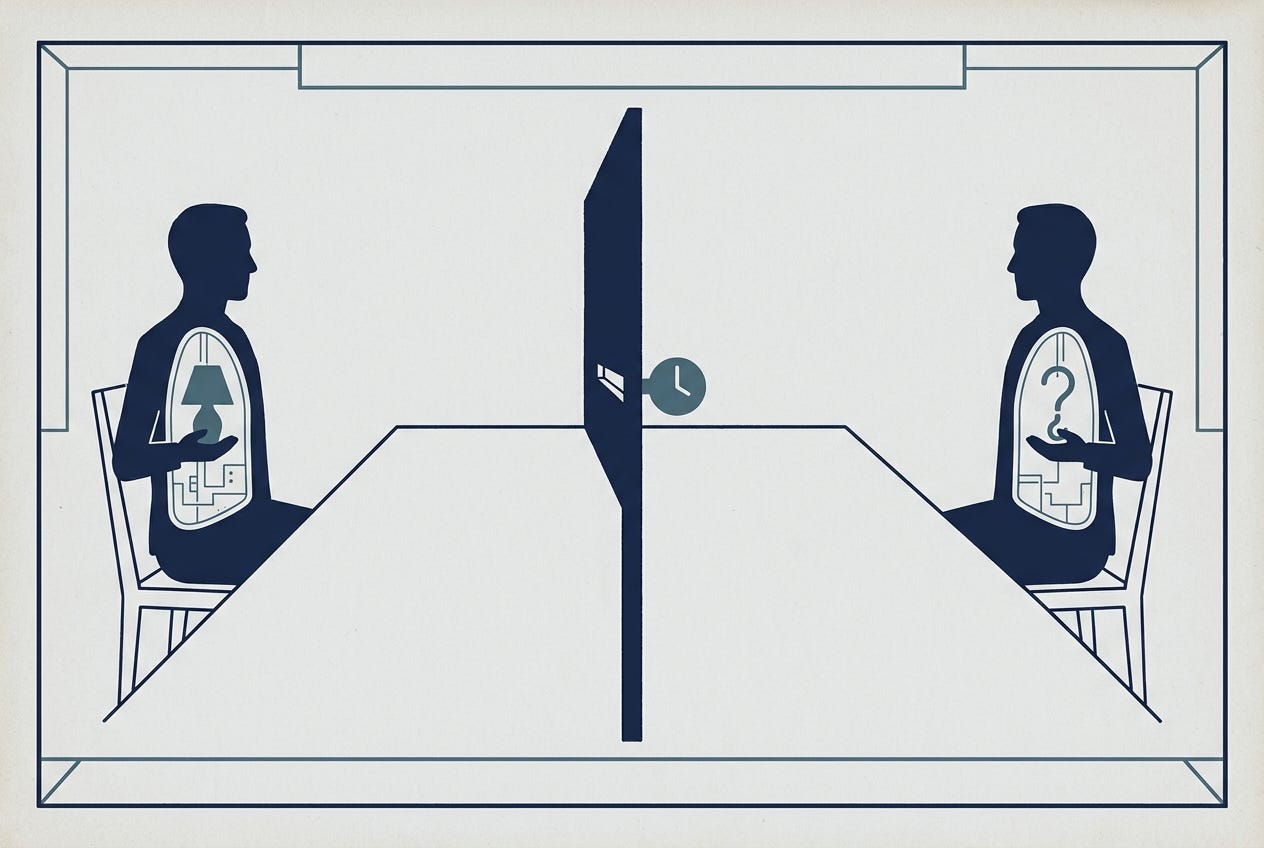
The leader in that room can see the usage curve. That is a real reading. It is also a Scott map: a simplification that makes the program governable from the center. What it cannot show is Dana, or the night-shift parent, or the hire that never happened because the junior role was the first thing the tool absorbed. Those are not on the curve. They are the ground, wearing a person’s name.
The person who spoke used challenging voice. Ethan Burris found that managers rate employees who challenge as worse performers and endorse their ideas less than the same ideas framed supportively. Elizabeth McClean and colleagues found that men who speak up with promotive ideas gain status and emerge as leaders, while women doing the same do not get the same return. If the most senior, most “one of us” person in that room had said the exact sentence about the night shift, the label would likely have been prudence.
Baseball staged this room at Fenway Park in April 1945. Under political pressure, the Red Sox held a tryout for Jackie Robinson, Sam Jethroe, and Marvin Williams. All three performed. None received a contract. The club did not field a Black player until 1959, the last team in the majors to do so. The evidence was on the field in front of them. The category did the reading.
Now turn the direction around. The leader left Tuesday’s meeting sure the team knew the rollout was meant to be fair. Fairness was vivid on the inside. On the outside, the evidence was an announcement and a green curve. Michael Spence’s point about signals is blunt. When one side can see something the other cannot, the receiver trusts only what would be costly to fake. An announcement is cheap. Paid learning time for the night shift is not.
Friday the curve is still green. The night shift is still teaching itself after hours. The objection has been filed under resistance. Nobody failed a character test. The room designed a reading, then treated the reading as the people.
PACE: Attend
I’ve built a framework called HEAL around four commitments: Humanity, Equity, Acceptance, and Love. It is not widely known yet, and I am developing it in public, one commitment at a time. HEAL names what good leadership looks like. PACE is the working protocol I am building alongside it, the way to practice HEAL at a humane speed: Pace, Attend, Cost, Endure. This month belongs to Attend.
Attend is the practice of noticing what your instruments cannot show, and deciding who is allowed to bring you the news. It is the opposite of adding another slide. Acceptance, in HEAL, is the refusal to mistake the measurable for the real. Attend turns that refusal into a weekly habit and aims it in both directions.
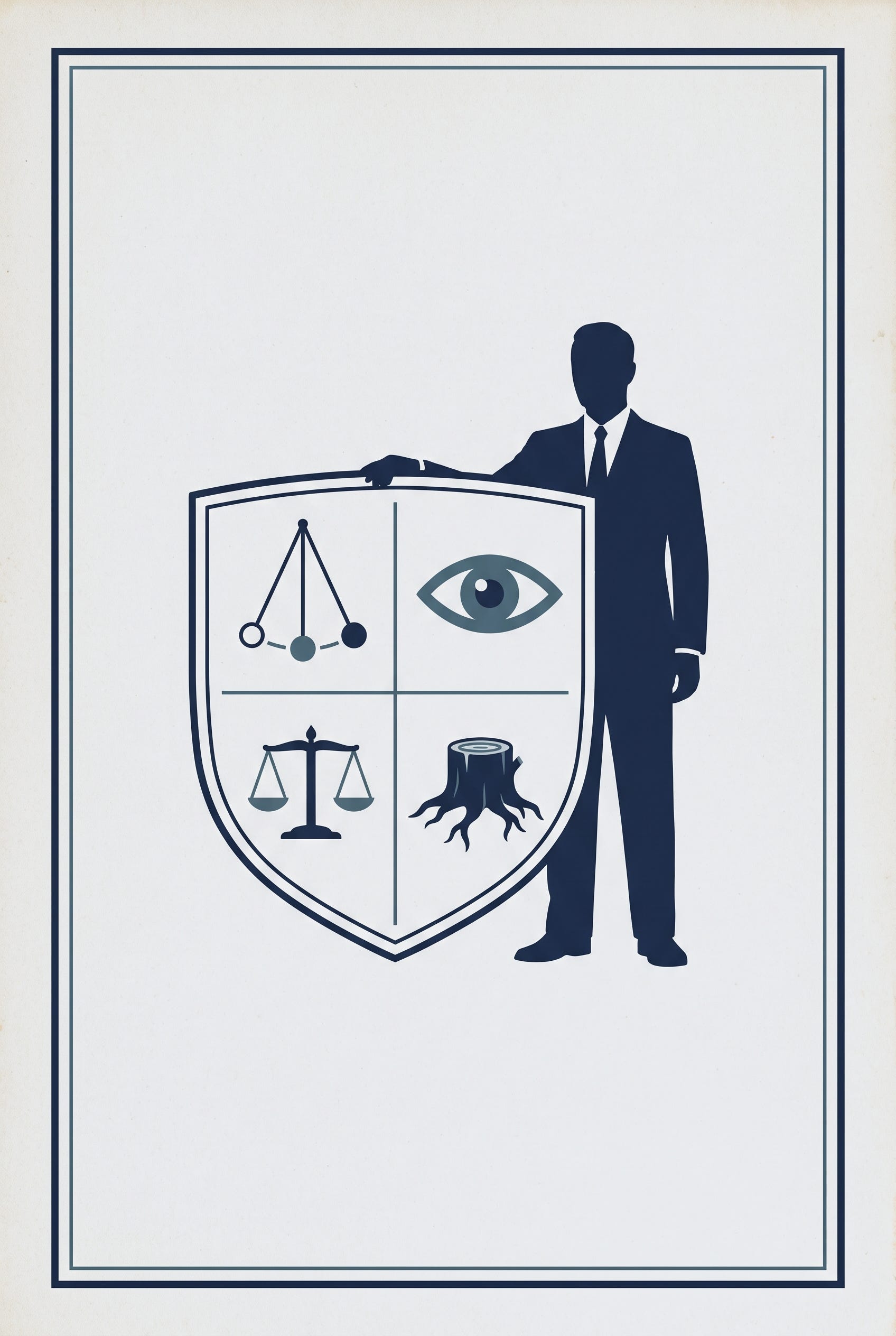
In the book I am writing, a first-year VP named Jordan decides to stay calm when a critical production bug lands. She believes she is steady and reassuring. Later a colleague tells her she tapped her pen the entire time the problem was being explained. When Jordan goes back and asks the person who brought her the bug what she saw, the answer is “tense and distant.” Jordan reaches the conclusion every leader eventually reaches: people cannot see what you are thinking. They can only see what you show them. Leadership is measured by effect, not intention.
You cannot Attend if the only voices that reach you already sound like you. You cannot Attend if the only proof of your fairness is that you feel fair. The first is how you read them. The second is how they read you.
Attend has to come before Cost for a reason. Cost is the signal that actually crosses the gap: a changed budget line, a protected hour, a moved date, a stranger allowed to check the work. In September, Dario Amodei’s call to slow the pace of AI capability gains read differently from the usual safety statements because it arrived with a cost attached: permanent, employee-level access for independent evaluators, and a direct competitor pledging to match it. Words with nothing at stake get read as positioning. Your team applies that same test to you. They are not being cynical. They are reading the only thing that can be read.
Attend first, so the cost you spend is spent on the thing that was actually there.
Practice of the Month: the read-back
A short, repeatable turn across both sides of the gap. Run it for four weeks.
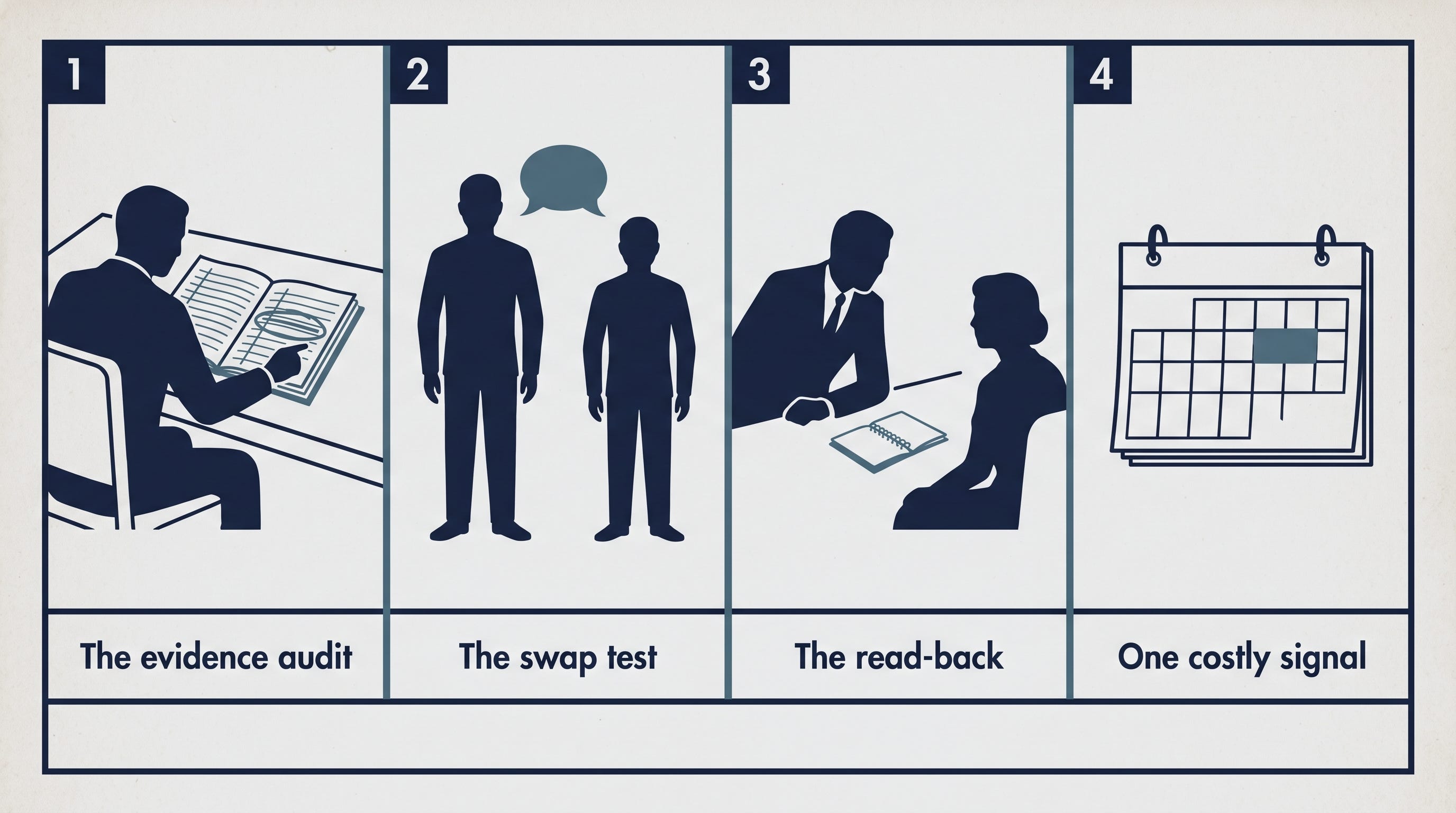
One. The evidence audit. Write down three things you believe your team knows about you: a fairness, a care, a commitment. Next to each, list the evidence someone outside your head could point to: a budget line, a calendar block, a changed decision, a role redesigned. Circle any line that is blank or says only “I told them.” That is intent. It has not crossed.
Two. The swap test. Once a week, notice when you silently label someone’s pushback as resistance, negativity, or “not on board.” Ask: if the most senior, most “one of us” person in the room had said this exact sentence, what would I have called it? If the label changes, the category was doing the reading. Note it. Do not fix it yet.
Three. The read-back. Ask two people at different levels: “When I talk about the AI rollout, what do you hear it meaning for you?” Write down their words, not your interpretation. Compare them with what you meant. The difference is the gap, measured.
Four. One costly signal. Pick one circled line from the audit and back it with something that costs you: paid learning time, a protected hour, a moved date, an outside reviewer. Do not announce it. Let people find it.
The surface is what you said. The ground is what they could point to.
Reader question
What are you sure your team knows you mean, and what could they point to as proof?
Theory Reference
The spine of this piece is a gap between what is there and what can be read. Several bodies of work hold that spine up.
James C. Scott supplies the frame. States and other large systems simplify the world so they can see it from the center, and the simplification then replaces the local knowledge that made the thing work. A role, a stage model, and a dashboard are small versions of the same move. Batting average was a large one.
Michael Spence’s signaling theory starts from the same asymmetry on the other side of the table. One party knows something the other cannot observe. The receiver relies on signals, and a signal is credible only if it would be costly for someone without the underlying quality to fake it. Connelly and colleagues’ review of the management literature adds the part leaders miss: signals are interpreted. What the receiver attends to matters as much as what was sent.
When information is thin, interpretation falls back on category. Monika McDermott showed that in low-information elections, voters stereotype women and Black candidates as more liberal than comparable white men. That is the empirical base under Bouie’s argument. The social identity theory of leadership (Hogg; Haslam, Reicher, and Platow) finds that leaders who seem prototypical of the group get more trust and more room to act. Prototypicality is a free credibility signal. It is not distributed equally.
Voice research shows the organizational version of the same pattern. Burris found that challenging voice costs the speaker in performance ratings and costs the idea in endorsement. McClean and colleagues found that the status return on promotive voice depends on the gender of the person speaking. The sentence is not the whole reading. The speaker is.
Two further findings sit underneath the lenses. Cameron and Payne showed that people deliberately regulate their compassion down as the number of people in need goes up, which is why an aggregate makes suffering easier not to feel. Stroebe and colleagues reviewed the evidence on grief and cautioned against the stage model, which persists because it is readable, not because it is right. And Amy Edmondson’s work on psychological safety explains why the quiet room stays quiet: when speaking up carries interpersonal risk, the truest signal never becomes public, and the instrument reports only what felt safe to report.
The thread joining them: in a low-information change, leaders will read people by category and people will read leaders by cost. Where either reading fills the gap, it fills it with assumptions.
Further Reading
Books
Haslam, S. A., Reicher, S. D., & Platow, M. J. (2020). The new psychology of leadership: Identity, influence and power (2nd ed.). Routledge.
Scott, J. C. (1998). Seeing like a state: How certain schemes to improve the human condition have failed. Yale University Press.
Short reads
Amodei, D. (2026, September 12). We must pace the frontier. [ADD URL]
Brynjolfsson, E., Chandar, B., & Chen, R. (2026, August 12). Canaries in the coal mine? Six facts about the recent employment effects of artificial intelligence (Rev. ed.). Stanford Digital Economy Lab. https://digitaleconomy.stanford.edu/publications/canaries-in-the-coal-mine/
Burris, E. R. (2012). The risks and rewards of speaking up: Managerial responses to employee voice. Academy of Management Journal, 55(4), 851–875. https://doi.org/10.5465/amj.2010.0562
Cameron, C. D., & Payne, B. K. (2011). Escaping affect: How motivated emotion regulation creates insensitivity to mass suffering. Journal of Personality and Social Psychology, 100(1), 1–15. https://doi.org/10.1037/a0021643
Connelly, B. L., Certo, S. T., Ireland, R. D., & Reutzel, C. R. (2011). Signaling theory: A review and assessment. Journal of Management, 37(1), 39–67. https://doi.org/10.1177/0149206310388419
Demby, G., Parker, B. A., & Bouie, J. (2026, September 22). Do voters want woke? [Audio podcast episode]. In Code Switch. NPR. https://www.npr.org/2026/09/22/nx-s1-5976899/do-voters-want-woke
Edmondson, A. (1999). Psychological safety and learning behavior in work teams. Administrative Science Quarterly, 44(2), 350–383. https://doi.org/10.2307/2666999
Hogg, M. A. (2001). A social identity theory of leadership. Personality and Social Psychology Review, 5(3), 184–200. https://doi.org/10.1207/S15327957PSPR0503_1
McClean, E. J., Martin, S. R., Emich, K. J., & Woodruff, C. T. (2018). The social consequences of voice: An examination of voice type and gender on status and subsequent leader emergence. Academy of Management Journal, 61(5), 1869–1891. https://doi.org/10.5465/amj.2016.0148
McDermott, M. L. (1998). Race and gender cues in low-information elections. Political Research Quarterly, 51(4), 895–918. https://doi.org/10.1177/106591299805100403
Spence, M. (1973). Job market signaling. The Quarterly Journal of Economics, 87(3), 355–374. https://doi.org/10.2307/1882010
Stroebe, M., Schut, H., & Boerner, K. (2017). Cautioning health-care professionals: Bereaved persons are misguided through the stages of grief. OMEGA: Journal of Death and Dying, 74(4), 455–473. https://doi.org/10.1177/0030222817691870
Practice of Thinking is the monthly companion to Theory Meets Tuesday from Unified Purpose. Monthly reflections on leadership practice. Replies are read.