


Companion Post: The Exploration Budget

This week’s Theory Meets Tuesday, The Play Deficit, looked at the overjustification effect: when something people chose freely becomes the means to an expected, evaluated end, the interest behind it fades. The leadership decision is not whether to allow exploration. It is when evaluation begins.
The Exploration Budget is a one-page tool for making that decision on purpose. Use it at your next planning cycle, or any time you notice the roadmap has no empty cells.
The Exploration Budget
The Exploration Budget (Episode 025)
Part 1: The 30-Day Diagnostic
Answer each question with a specific example, not a general impression.
In the last 30 days, where did someone on your team pursue a question or idea before anyone evaluated it?
In the last 30 days, where did evaluation begin before exploration had a chance?
When someone last brought you an unfinished idea, what was the first question you asked?
If the answer to the first question is “nowhere,” that is your finding.
Part 2: Three Design Questions
1. The window. What time, attention, or resources are available for voluntary exploration with no required deliverable? Write a number: hours per person per month, a standing day, or a defined budget. If you cannot name it, it does not exist.
2. The transition. What is the explicit rule for when an exploration moves into a bounded trial with feedback? Name who decides, what signal triggers the move, and what the trial will test.
3. The protection. How will you keep the voluntary character intact so exploration does not become another performance expectation? Name what will not be tracked, reported, or reviewed during the window.
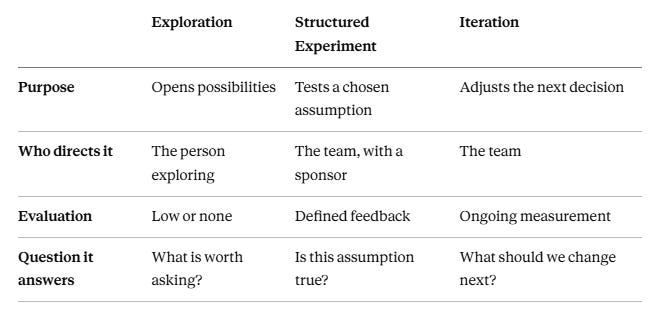
Part 3: Three Kinds of Work
These are related but not interchangeable. The tool’s job is to keep the first from collapsing into the other two.
Part 4: Guardrails
Exploration cannot be assigned. It can only be protected.
Do not ask for a deliverable during the window. Ask what the person is curious about.
Recognition that arrives as a surprise informs. Recognition promised in advance controls.
An exploration that ends with “nothing here” is a result, not a failure.
A note on the evidence: the developmental research on play is stronger than the workplace research, and the workplace studies are largely associative or drawn from single firms. This tool is a leadership translation of the science, not a claim that the science has already proven it.
Curiosity cannot be scheduled. The space for it can.
Theory Meets Tuesday is the weekly edition from Unified Purpose. Smarter leadership for the real world. Replies are read.