


Issue 004 · September 2026
The framework problem
Every leader is handed a set of readings. The delivery dates showing green. The channels that stayed active. The room that nodded. The alert that lit up this morning and asked for an answer before lunch. These readings are real. They are immediate. And they are almost never the thing that decides whether the work is any good.
Underneath the readings there is a substrate. It carries no gauge. It is the integrity of the filters you set on incoming information, the safety that lets a quiet objection become a spoken one, the calibration of judgment that separates a true signal from a loud one, the unbroken stretch of attention that turns raw input into direction. None of it can be counted in the moment. You notice it only when it gives way, and by then the reading has been green for a month.
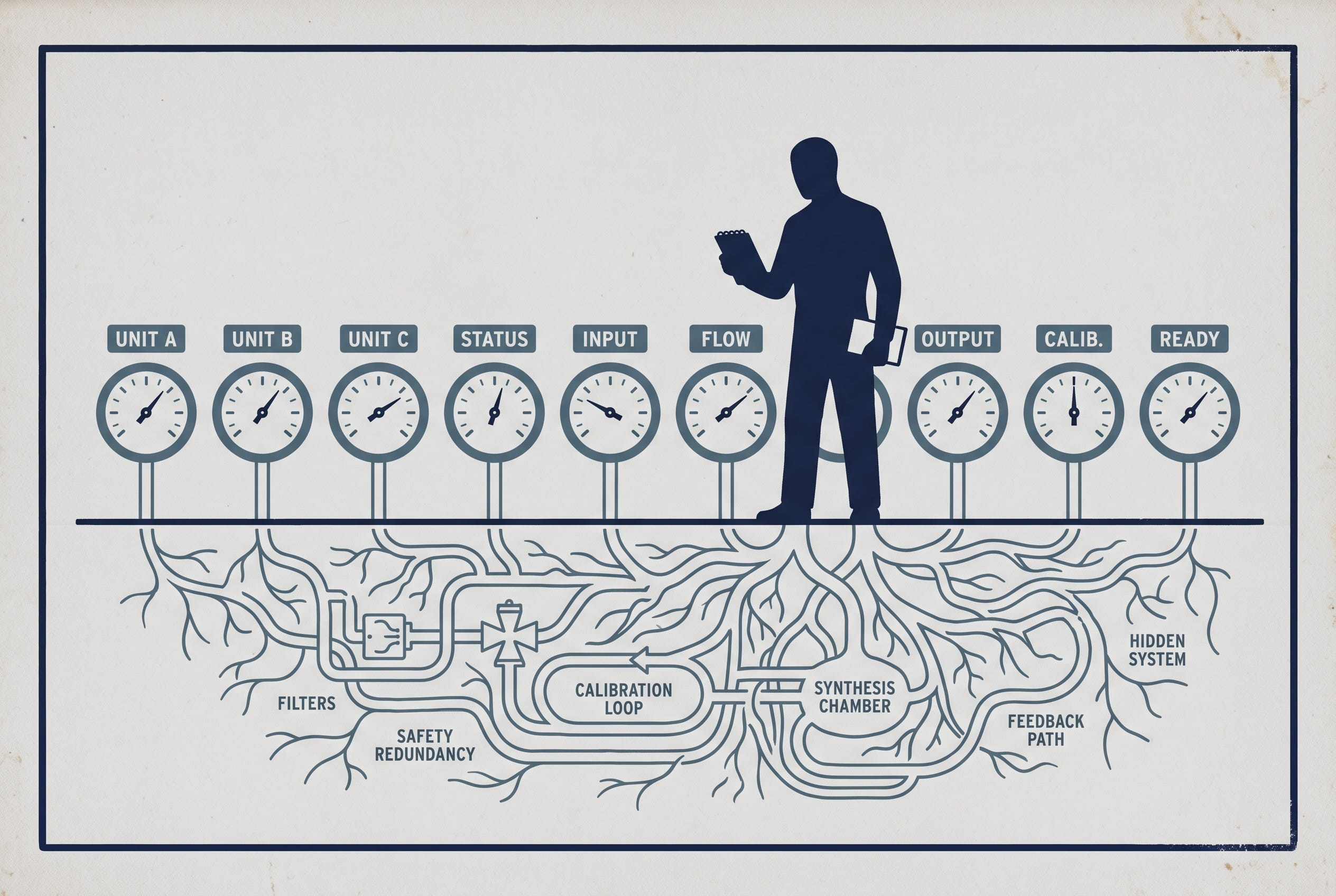
This is a piece about that gap: the surface a leader manages, and the ground a leader stands on. The uncomfortable claim beneath everything that follows is simple. Leaders keep optimizing what shows up, while the layer that actually governs the outcome sits below the surface, unmeasured, deciding quietly.
The distinction this issue turns on
A dashboard is an instrument for reading a surface. It is very good at telling you what already happened and what is happening loudly right now. It is structurally incapable of telling you about the ground, because the ground is made of capacities, not events, and capacities do not emit a number until they break.
This is the same fault line the publication keeps returning to: response-mode and design-mode. Response-mode lives on the surface. It reacts to what shows up, and what shows up is whatever is greenest, loudest, or latest. Design-mode tends the ground. It works on the conditions that determine what will show up next month, and whether you will be able to make sense of it when it does. The trap is that response-mode is legible and design-mode is not. You can show a board a full inbox cleared. You cannot show them a filter that quietly kept the wrong forty inputs from ever reaching the team.
Hold that distinction. The four movements below are one signal’s journey across it.
Four lenses: the anatomy of a signal
A signal does not arrive and resolve in a single step. It arrives, it is received, it is vetted, and it is integrated. At each stage there is a visible layer that behaves well and a substrate that is doing the actual governing. Watch the surface at each stage and you will feel fine, right up until you don’t.
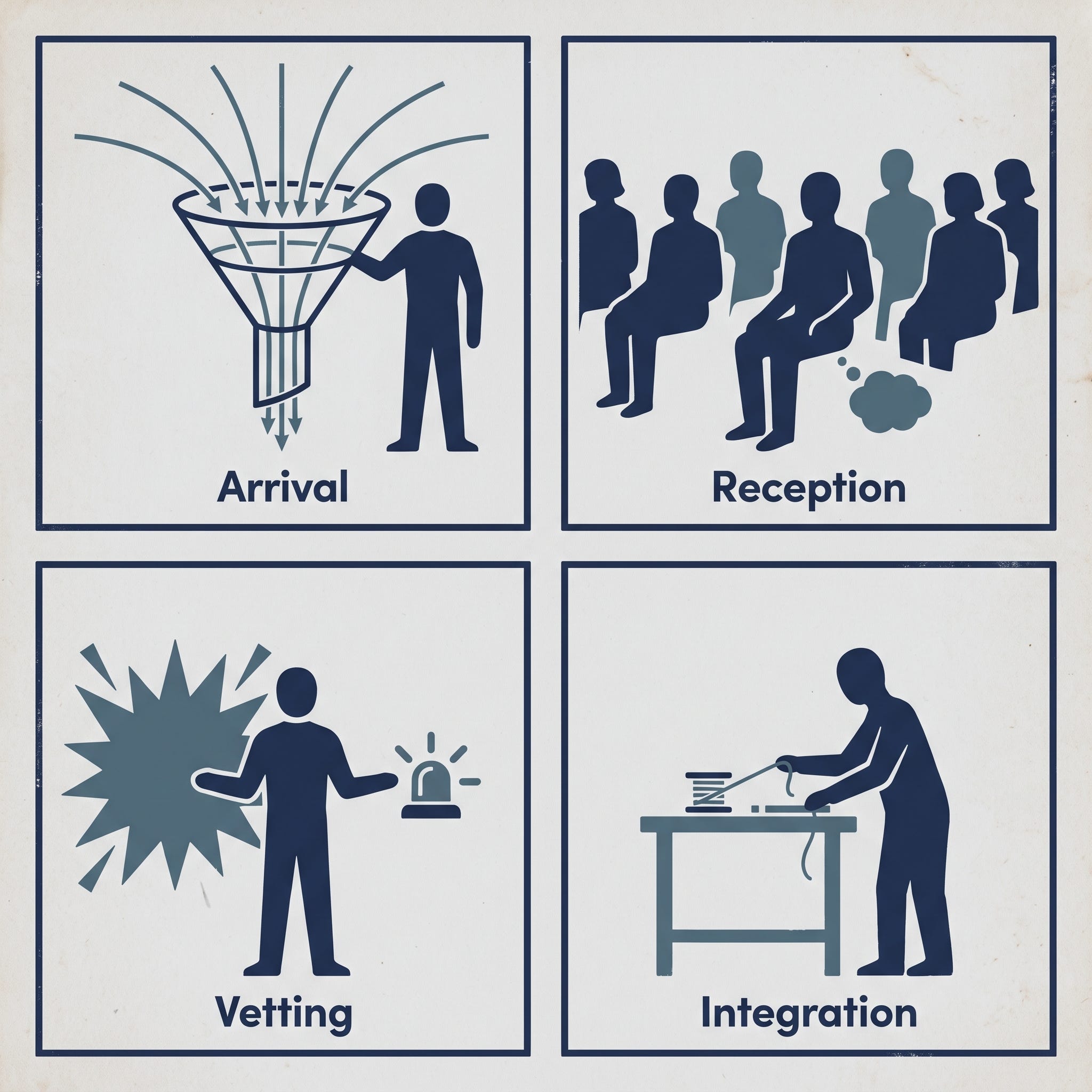
Arrival. The visible layer is the volume and freshness of what comes in: an active stream, plenty of inputs, nothing missed. The substrate is the filter that decides which of those inputs the team ever attends to. Information is not the scarce resource; it arrives in excess. Attention is the finite budget, and a budget spends itself whether or not you allocate it. Herbert Simon named this half a century ago: a wealth of information creates a poverty of attention. If you do not design the filter, you have not avoided designing it. You have simply handed the design to whichever input is loudest and most recent. The stream you did not design is still a stream you built, by default.
Reception. The visible layer is agreement: heads nod, no one objects, the meeting ends on time. The substrate is whether it was ever safe for a private doubt to surface as a public one. A quiet room reads as a room in consensus. Often it is a room where several people each privately disagree, and each privately assumes they are the only one, so each stays silent and confirms the silence for the others. Psychologists call this pluralistic ignorance, and its more active companion, the deliberate performance of an agreement you do not feel, has been studied as a facade of conformity. The signal that mattered most, the objection, never surfaced. And here the ground is not level. Whose private view becomes public is patterned by how much positional safety a person has to spend, which is exactly the terrain Crenshaw’s intersectionality maps. The person most likely to have seen the flaw may be the person least positioned to name it in that room. The silence you read as alignment is often the sound of the least protected voice deciding, correctly, that this is not the moment.
Vetting. The visible layer is vigilance: you caught the new thing, you responded fast, you looked on top of it. The substrate is discernment, the calibration that separates a reliable signal from a merely recent one. Recency and vividness make the newest, loudest input feel like the most important one, a bias Tversky and Kahneman traced to how easily an instance comes to mind rather than how often it is actually true. The cost of chasing a false positive is not the wasted afternoon. It is what the chase does to your calibration afterward. Each false alarm nudges future judgment toward one of two failure states: hyper-reactivity, where everything now looks urgent, or numbness, where nothing does. Discernment, then, is not a decision you make once. It is a capacity you protect so that the next call remains makeable.
Integration. The visible layer is velocity: output shipped, deadlines held, the meter still green. The substrate is the unbroken stretch of attention that synthesis actually requires. When you switch tasks under pressure, part of your attention stays snagged on the last thing. Sophie Leroy called this attention residue, and it is why the hour after a fragmented morning produces so much less than the hour looks like it should. Synthesis, the work of turning many inputs into one direction, is the first capacity to erode under constant switching and the last thing to register as a missed deadline. The meter you watch is the meter that moves last. By the time delivery slips, the capacity that produces good direction has been gone for weeks.
Three of those four movements set a fast, reactive pole against a slow, integrative one: responsiveness against direction, the newest signal against the truest one, velocity against synthesis. The dashboard is built to display the fast pole. The ground is made of the slow one. Which is another way of asking a harder question about your own week: is the timeline being driven by the judgment, or by the pressure?
Theory in Practice: a panel on signals
Picture a Tuesday. A client sends an urgent note, flagged twice, asking for a change by Friday. It is fresh, it is loud, it arrives at the top of the inbox. The leader reallocates two people to it that afternoon.
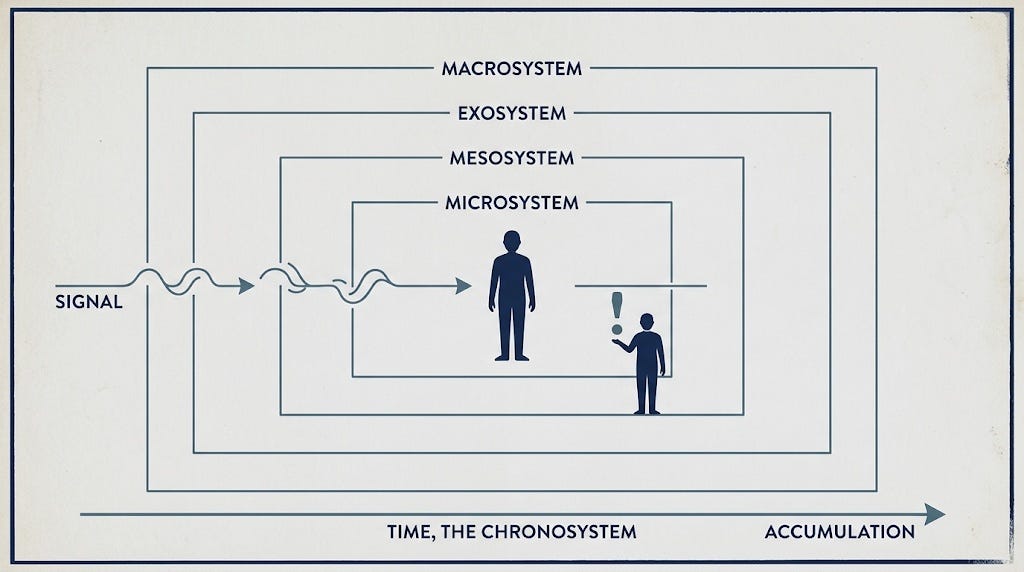
Watch the ripple move, not out across the org chart, but down through the nested systems a person actually lives inside. Bronfenbrenner’s ecology is useful here precisely because it refuses to locate the cause in any single place. In the immediate setting, the microsystem of that room, the reassignment lands as motion and relief: something is being done. One level out, in the mesosystem where that team’s work connects to the strategic review it was actually staffed for, the reassignment quietly pulls the synthesis block that review depended on. Further out sits the exosystem, the forces acting on the team from settings they do not sit in: the account pressure, the quarter, the history with that client, none of it present in the room, all of it shaping which signals get to be urgent. Wider still is the macrosystem, the ambient belief that a responsive leader is a good one, that fast is competent, that a cleared flag is a solved problem. And running through all of it is the chronosystem, time itself: this is the third such Tuesday this month, and the residue from each has been accumulating in a capacity no one is measuring.
Now the part the dashboard will never show. In the meeting where the reallocation was decided, one person had worked the client relationship long enough to know the Friday deadline was soft and the real risk lay elsewhere. She did not say so. Reading her silence as agreement is the error. Her calculation was ecological, not personal: in that room, with that history, the cost of being the lone objector fell more heavily on her than on others, and she spent her attention on that calculation instead of on the objection. The signal that would have redirected the team was present in the room and never made it to air.
Friday comes. The change ships. The meter is green. The strategic review, three weeks later, is thin, because the synthesis that would have made it sharp was spent on a deadline that was never hard. Nobody failed a willpower test. The leader did not lack character. The leader designed a stream that rewarded the loudest arrival, ran a room where the truest signal could not safely surface, prized the chase over the calibration, and watched the one meter that moves last. The conditions produced the outcome, and the conditions had an author.
HEAL: Acceptance
Humanity asks a leader to see the person and not the resource. Equity asks a leader to account for the different grounds people are standing on, and the different ripples a single event sends through different lives. Acceptance asks something quieter, and for a certain kind of leader, harder. It asks you to come to terms with what is actually true beneath the readings, including the parts you cannot measure and the part you would rather not own.
Acceptance is not resignation, and it is not the serenity of giving up. It is the disciplined refusal to mistake the measurable for the real. Its whole work is the subtraction of comfortable illusions, and there are three the dashboard is especially good at selling.

The first is that attention is unlimited. It is not, and no amount of will refills it. A leader who accepts this stops treating the team’s capacity to attend as a free input and starts treating it as the scarce budget it is, to be spent on purpose. The second illusion is that silence is consent. Acceptance means receiving a quiet room as a question rather than an answer, staying curious about the objection that did not surface rather than relieved that none did. The third, and the one that costs the most to accept, is that you built the conditions. Not all of them; the exosystem and the macrosystem press on every leader from outside. But the filter, the safety of the room, what gets rewarded as urgent, which meter you watch: those are yours. Acceptance here is not self-blame, which is only another way of staying on the surface, this time the surface of your own feelings. It is ownership, which is the one posture from which the ground can actually be tended.
There is a reason acceptance has to come before the practice, and not after. You cannot redesign a stream you insist is already fine. You cannot protect a capacity you refuse to admit is finite. The leader who accepts the substrate as real, limited, and partly of their own making is the only leader in a position to do anything about it. Everyone else is still optimizing the reading.
Practice of the Month: a ripple check
A short, repeatable turn from surface to ground. Run it once a week, before you look at the dashboard, not after.
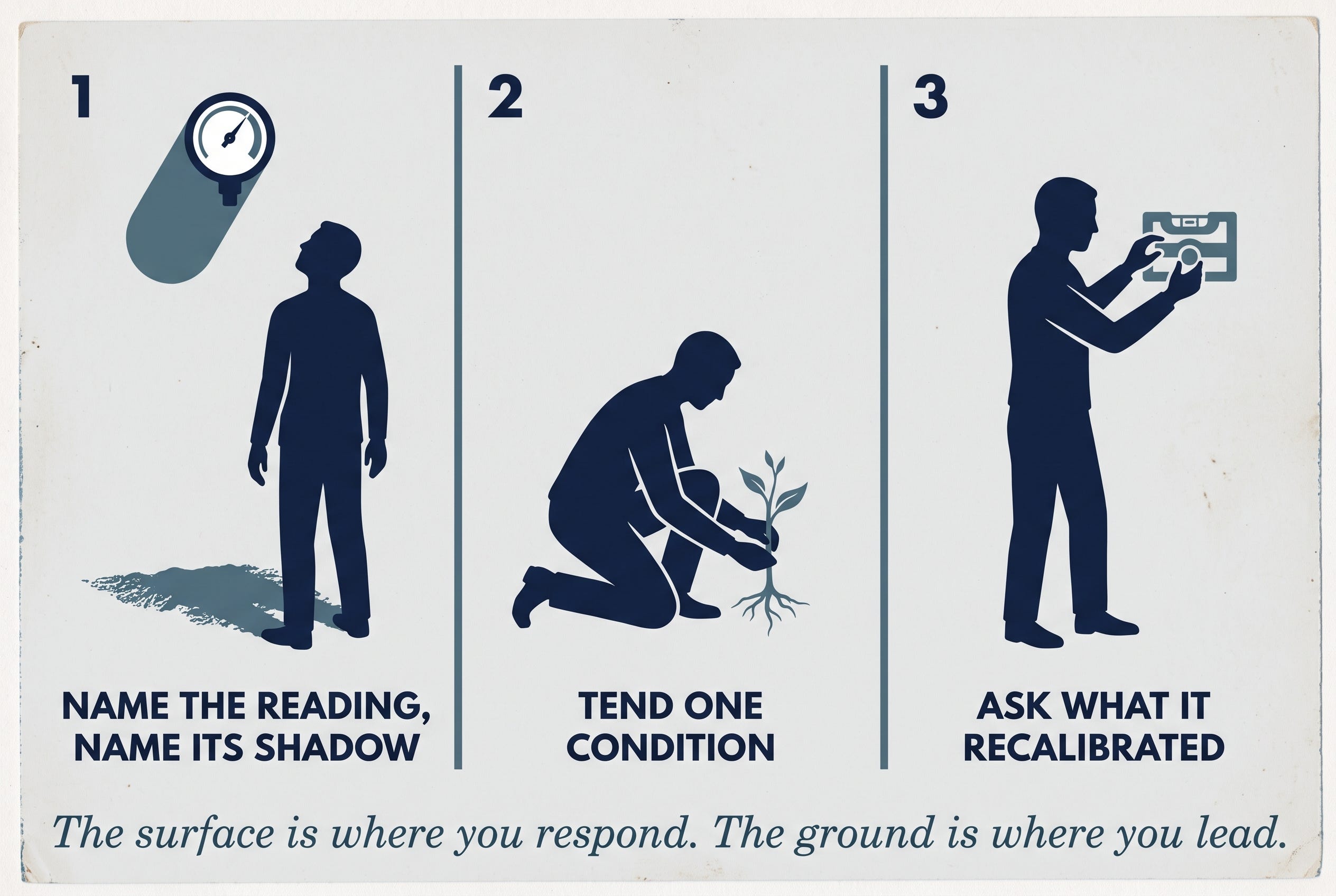
One. Name the reading you trust most, then name what it hides. Take the single metric that makes you feel most in control this week. Say it out loud, then ask what capacity it is standing in front of. “Delivery is green” stands in front of “when did this team last have an unbroken stretch to think?” The point is not to distrust the reading. It is to see the ground it is casting a shadow over.
Two. Tend one condition, not one output. Pick a single substrate move for the week and protect it as if it were a deadline: design one real filter on incoming information, defend one unbroken synthesis block on the calendar, or issue one explicit and safe invitation for the objection you suspect is being withheld. One is enough. The ground is tended slowly.
Three. After the next chase, ask what it recalibrated. When you have run down an urgent signal, do not only tally what it cost in hours. Ask what it did to your judgment. Did it teach the team that loud equals important? Did it move your own dial toward reactivity, or toward numbness? Name the recalibration, because that, and not the afternoon, is the real bill.
The surface is where you respond. The ground is where you lead.
Reader question
Which signal do you trust most right now and what is it letting you not look at?
Theory Reference
The foundation of this piece is a distinction between what can be measured in the moment and what governs the outcome underneath. Several bodies of work hold that spine up.
Herbert Simon supplied the founding observation for the whole information age: when information becomes abundant, the binding constraint shifts to attention, which information consumes. That single reframing turns “we need more data” into “we need to protect what attends to the data,” and it is why every stage in this piece treats the receiver, not the supply, as the bottleneck.
Urie Bronfenbrenner’s ecological systems theory gives the ripples somewhere to travel. He modeled human behavior as nested inside systems: the immediate microsystem, the mesosystem of connections between settings, the exosystem of forces acting on a person from settings they do not occupy, the macrosystem of surrounding culture, and the chronosystem of change over time. Read through this frame, the invisible substrate is not a private trait a leader happens to lack. It is a property of the systems the leader designs and mediates, which is what makes ownership possible without collapsing it into blame.
Kimberlé Crenshaw’s intersectionality explains why the substrate is unevenly distributed and unevenly visible. Positional safety, the currency a person spends to turn a private view into a public one, is not handed out equally, and it patterns whose signal surfaces and whose stays underground. The quiet room is quiet in a particular shape.
Two adjacent findings explain that quiet directly. Deborah Prentice and Dale Miller’s work on pluralistic ignorance shows how a group of privately dissenting people can each mistake the others’ silence for agreement, and so manufacture a consensus none of them holds. Patricia Hewlin’s research on facades of conformity adds the active version: people who suppress their real views and perform an alignment they do not feel. Amy Edmondson’s work on psychological safety names the condition under which either pattern reverses, the shared belief that speaking up is safe.
For the chase, Amos Tversky and Daniel Kahneman’s work on the availability heuristic explains why the newest and most vivid signal feels like the most important one: we judge importance by how easily an example comes to mind, not by how reliable it is. And for the residue, Sophie Leroy’s research on attention residue shows why switching tasks leaves part of your attention behind on the last one, degrading the synthesis the next task requires long before any deadline registers the loss.
The thread joining all of them: the layer that determines quality is the one no instrument reads in the moment.
Further Reading
Books
Bronfenbrenner, U. (1979). The ecology of human development: Experiments by nature and design. Harvard University Press.
Edmondson, A. C. (2019). The fearless organization: Creating psychological safety in the workplace for learning, innovation, and growth. Wiley.
Kahneman, D. (2011). Thinking, fast and slow. Farrar, Straus and Giroux.
Shorter reads
Crenshaw, K. (1991). Mapping the margins: Intersectionality, identity politics, and violence against women of color. Stanford Law Review, 43(6), 1241–1299. https://doi.org/10.2307/1229039
Hewlin, P. F. (2003). And the award for best actor goes to...: Facades of conformity in organizational settings. Academy of Management Review, 28(1), 67–80. https://doi.org/10.5465/amr.2003.8925227
Leroy, S. (2009). Why is it so hard to do my work? The challenge of attention residue when switching between work tasks. Organizational Behavior and Human Decision Processes, 109(2), 168–181. https://doi.org/10.1016/j.obhdp.2009.04.002
Prentice, D. A., & Miller, D. T. (1993). Pluralistic ignorance and alcohol use on campus: Some consequences of misperceiving the social norm. Journal of Personality and Social Psychology, 64(2), 243–256. https://doi.org/10.1037/0022-3514.64.2.243
Simon, H. A. (1971). Designing organizations for an information-rich world. In M. Greenberger (Ed.), Computers, communications, and the public interest (pp. 37–72). Johns Hopkins Press.
Practice of Thinking is the monthly companion to Theory Meets Tuesday from Unified Purpose. Monthly reflections on leadership practice. Replies are read.