


Issue 001 · June 2026
Why this edition exists Q
The weekly is built for the moment. A leader is mid-week, mid-meeting, mid-decision, and needs a single idea sharp enough to use before Friday. That format does what it is supposed to do, and it has a limit. Some patterns only show up when you stand further back.
Practice of Thinking is that step back. Once a month, we treat the prior weeks as one piece of writing rather than several. We name what they have in common, take the underlying idea further than any single edition can, and end with one practice to run for the next four weeks.
This is the first one. So before the synthesis, the simplest possible question. What were the last four weeks actually about?
Opening: response-mode vs. design-mode
Most of the leaders I work with do not have a style problem. They have a mode problem.
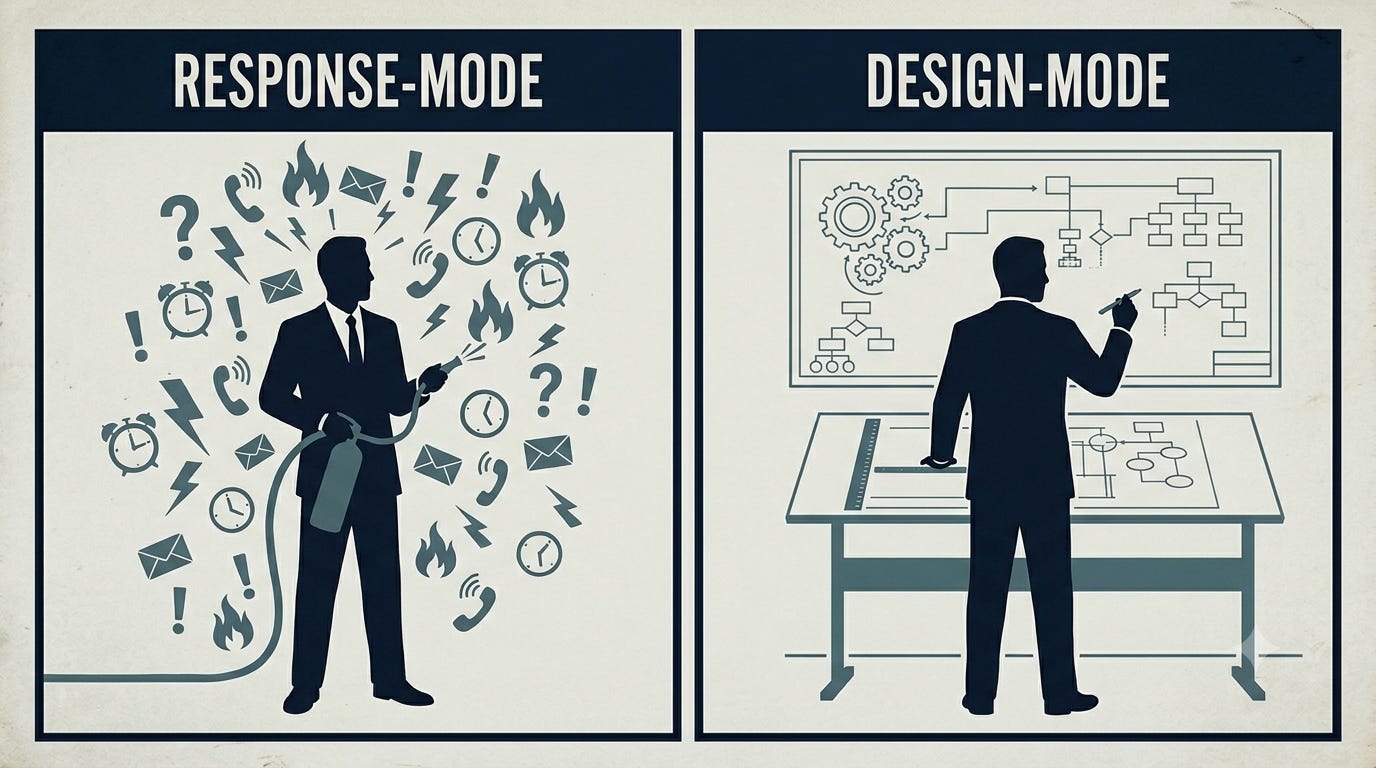
On paper, they are experienced, thoughtful, and more than capable of strategic thinking. In reality, their calendars tell a different story. A week of escalations, approvals, Slack pings, and quick syncs that never quite add up to a coherent direction. They are stuck in response-mode. A mode that rewards speed, availability, and short-term problem solving, often at the expense of real design work.
Response-mode is not inherently bad. When production is down, a security incident hits, or a key customer is on fire, you want leaders who can move quickly and triage. The problem is what happens when response-mode stops being an occasional state and becomes the default. Over time, leaders find themselves solving the same problems over and over because the underlying system never changes.
The alternative is what I will call design-mode. In design-mode, the unit of work is not the ticket, the escalation, or the email. The unit of work is the system. The incentives, decision rules, structures, and rituals that generate those tickets and escalations in the first place. Design-mode is slower in the moment and far less visible on a dashboard, but it is the only mode that can permanently retire certain classes of problems.
Here is the catch. Pluralism makes design-mode expensive. In plural, high-stakes rooms, where different functions, disciplines, geographies, and ideologies collide, any design choice will create winners and losers. It will privilege some values over others, some teams over others, some risks over others. Faced with that reality, many leaders retreat back into response-mode, where they can be endlessly helpful without ever making the kind of irreversible design decisions that might empty the room. That retreat is understandable. It is also how organizations slowly burn out their best leaders.
This month is about noticing your own mode, understanding how pluralism pulls you back into response-mode, and experimenting with structures that make design-mode a normal part of how you lead, not a rare luxury reserved for offsites and strategy retreats.
The month in four lenses
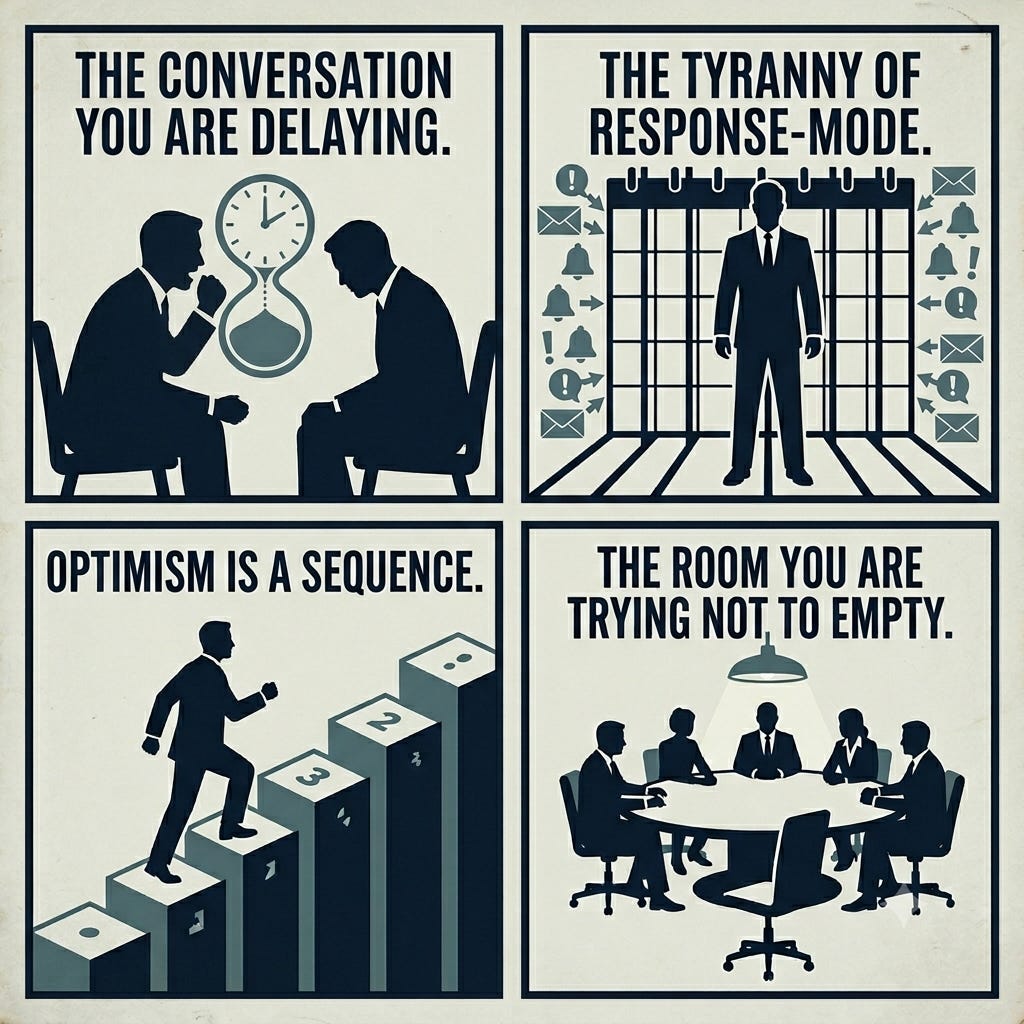
The last month of writing touched the same problem at four different points in the system. Read together, each piece becomes a different view of leaders trapped in response-mode.
The conversation you are delaying. When you delay a hard conversation, you are often delaying a design choice. In response-mode, the cost of that delay is easy to hide. You handle issues as they arise and keep relationships smooth. In design-mode, you treat the delayed conversation as a signal that a structure, standard, or decision rule needs to change, so the same conflict does not keep reappearing in slightly different clothes.
The tyranny of response-mode. This was the most literal description of life in response-mode. A calendar built for other people’s urgency. What that piece did not fully name is that response-mode is not just an overload problem, it is an identity problem. Many senior leaders have built a career and a reputation on being the one who can always respond. Design-mode asks them to be something different. The one who can redesign the game so fewer emergencies require their presence at all.
Optimism is a sequence. Optimism makes sense only if you can see a plausible sequence from here to there. Response-mode shortens your time horizon until the only sequence you can see is problem, my intervention, temporary relief. Design-mode restores longer sequences. Pattern, system redesign, new pattern. With it comes a more grounded form of optimism about what is actually changeable in your organization.
The room you are trying not to empty. Pluralism is one of the biggest forces keeping leaders in response-mode. As long as you treat pluralism as something to manage interpersonally, making sure everyone feels heard and keeping everyone in the room, you will tend to favor reversible, tactical responses over harder, structural design choices. In this monthly, pluralism becomes a design constraint instead of a purely relational problem. You are designing systems in which not everyone’s priorities can win all the time, and you are willing to be explicit about that.
If last month was about noticing your mode, the next month is about the constraints, rituals, and stance that make design-mode less fragile and less dependent on individual heroics.
Theory in Practice: leadership modes, not leadership styles
Leadership writing loves styles. Transformational, servant, democratic, coaching. The lists grow longer every year. Styles can be useful for self-reflection, but they often imply that leadership is a fixed personality trait. You find your style, you optimize it, and you hope the world cooperates. That is not the world most senior leaders live in.
A more useful lens, especially in complex organizations, is leadership modes. Recent work treats how you show up not as a single style but as a set of recurring states. Configurations of Affect, Behavior, Cognition, and Desire (ABCD) that get triggered by context (IMD, 2026; Jacobs, 2025). In one mode, your affect might be anxious and urgent, your behavior highly responsive, your cognition focused on immediate threats, and your desire aimed at restoring stability as fast as possible. In another mode, your affect is more spacious, your behavior more probing and reflective, your cognition oriented to patterns and systems, your desire focused on long-term health.
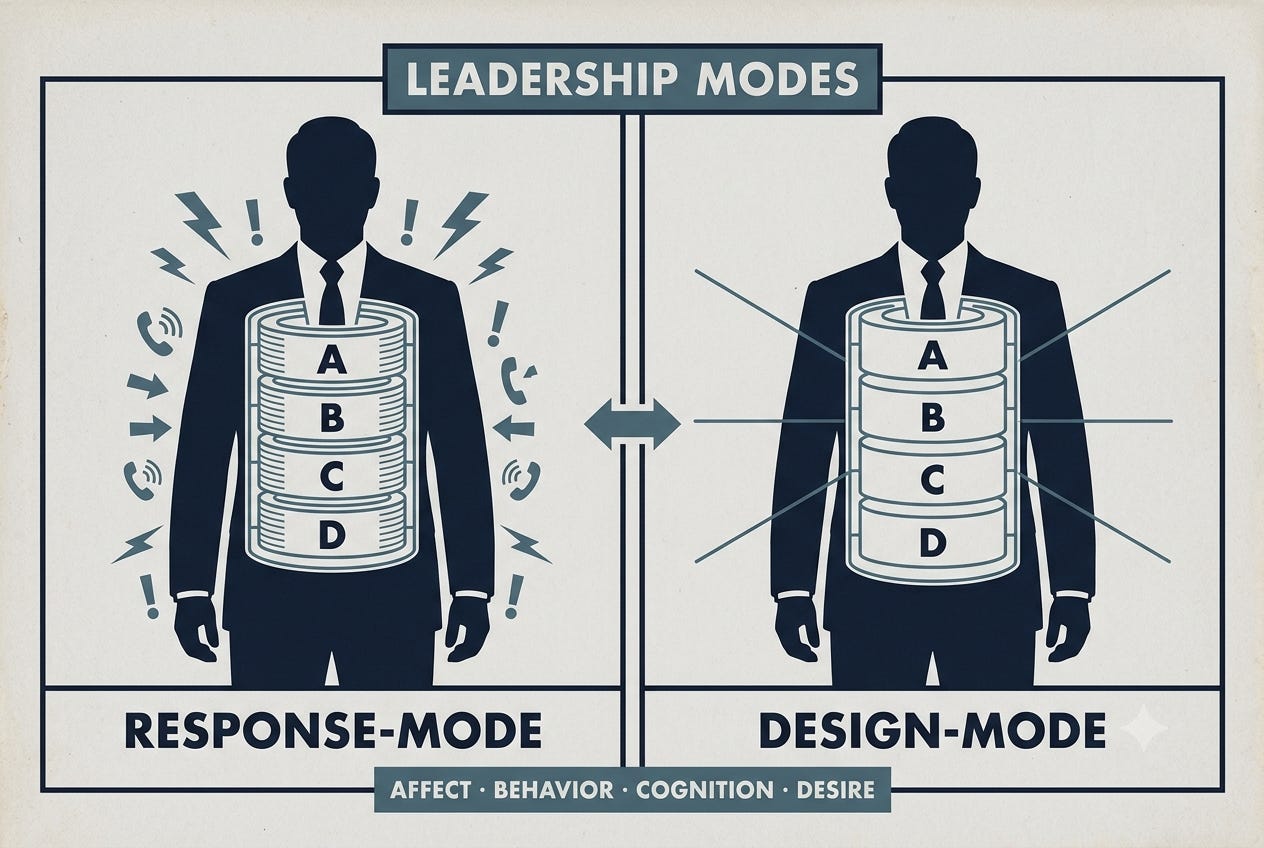
Response-mode and design-mode map neatly onto this idea. Response-mode is a leadership state where the ABCD stack is organized around relief. Relieve the pressure, relieve the stakeholder, relieve the risk. Design-mode is a state organized around reconfiguration. Change the underlying conditions so the pressure shows up differently next time, or not at all. Neither mode is your personality. They are trained, situationally cued ways of being that you can learn to enter and exit more deliberately.
This distinction has antecedents worth knowing. Some developmental models describe a move from reactive to creative and ultimately integral leadership, emphasizing an expanded capacity to see and shape systems rather than merely respond to them (Harris, 2023). Others, writing in practical terms for operators, contrast problem-solver and designer modes. In problem-solver mode the unit of work is the incident or escalation. In designer mode the unit of work is the system that produces those incidents (Kroman, 2025). Related literatures on decision-making models likewise distinguish between local, case-by-case decisions and higher-level choices about decision rights, structures, and the mechanisms that balance authority, consensus, and exploration (MIT HR, n.d.; Range, 2022).
This is also where pluralism enters the theory. Plural systems, where multiple legitimate values and worldviews coexist, are more likely to trigger defensive or appeasing modes, especially in senior leaders who feel responsible for holding the whole thing together (SAGE Handbook of Leadership). Scholarship on plural leadership and on principled pluralism emphasizes the coexistence of multiple legitimate value systems and the importance of holding strong convictions while engaging constructively across deep difference (Bush Institute and Interfaith America, 2026; Walsh and McKenzie, 2026; Wake Forest University, 2022). In such settings, the political and emotional cost of structural decisions is higher, because any design choice will visibly advantage some values and constituencies over others. That reality makes certain defensive modes more attractive. Leaders may remain in response-mode, handling issues one by one, precisely to avoid the conflict that explicit design decisions would surface.
The practical claim is not that design-mode replaces response-mode. It is that leaders in plural, complex systems need much greater range and intentionality about their modes. The work of leadership becomes, in part, the work of diagnosing one’s current mode, understanding the contextual triggers that keep one locked in response-mode, and building structures and rituals that make regular entry into design-mode both possible and expected.
Introducing HEAL: the stance design-mode requires
Modes describe a leader’s state. They do not, by themselves, describe what the leader is carrying into that state. A leader can be in design-mode and still produce cold, technocratic design choices that solve the wrong problem because the human texture of the room never entered the analysis.
HEAL is the stance that prevents that failure. It is what a leader brings into design-mode, especially when pluralism is in the room.
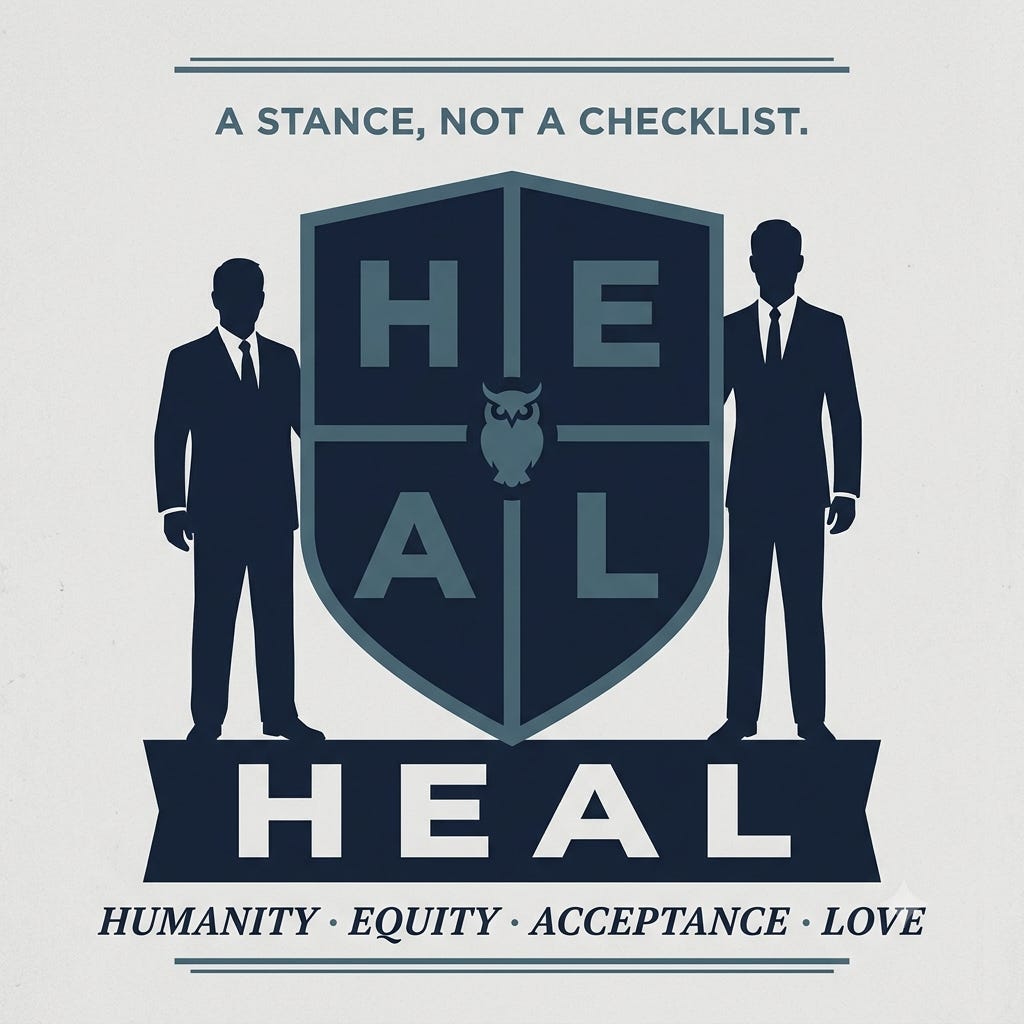
Humanity. People are seen as complete human beings before they are seen as productivity metrics. In design-mode, this is what stops a structural redesign from quietly treating people as throughput.
Equity. Team members face uneven obstacles in meeting the same expectations. In design-mode, this is what keeps the redesign from optimizing for the people who already have the easiest path through the system.
Acceptance. Active space is created for perspectives that challenge the leader’s own assumptions. In design-mode, this is what prevents redesign from becoming the leader’s preferences hardened into structure.
Love. Every intervention is grounded in genuine care for the wellbeing of people, the quality of the product, and the impact on customers. In design-mode, this is what keeps the work from drifting into pure systems abstraction.
HEAL is not an acronym to memorize. It is the stance that makes design-mode trustworthy in a plural organization. Without it, design-mode produces clean systems that quietly disrespect the people inside them. With it, design-mode produces systems that are honest about tradeoffs and humane about the people bearing them.
The upcoming weeks will return to HEAL one letter at a time, in the context of the pluralism arc. Humanity is what makes pluralism humane rather than transactional. Equity is what keeps it honest about who is bearing what. Acceptance is what gives it real intellectual range. Love is what keeps it from curdling into ideology.
Practice of the Month: the design-mode block
Theory does not shift calendars. Practices do. For the next four weeks, run a simple experiment. Create one design-mode block in your leadership practice and protect it like you would a board meeting.
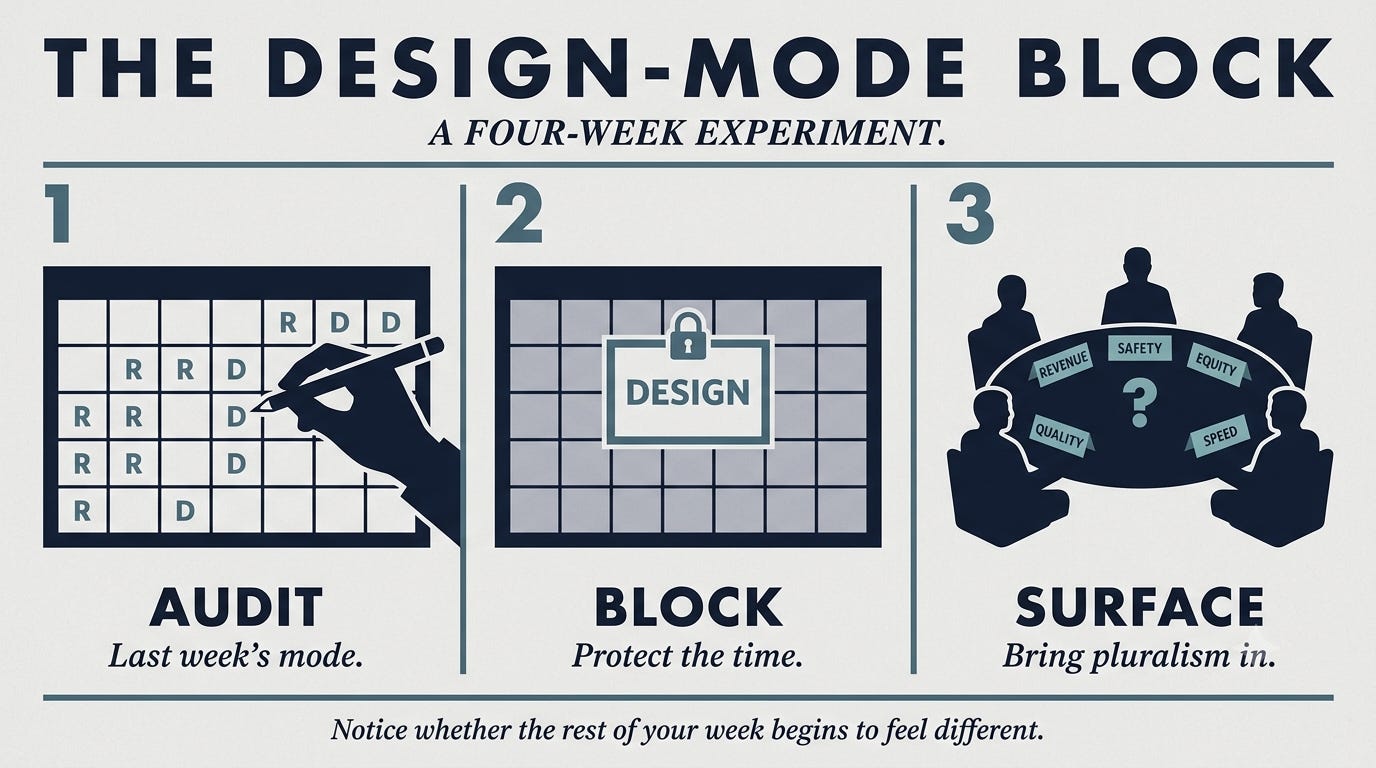
Step 1. Audit last week’s mode. Look back at your calendar from the last seven to ten days. For each meeting or major block of time, quickly tag it as R (response) or D (design). Response blocks are those where the primary goal was to answer, fix, approve, or triage. Design blocks are those where the primary goal was to reshape structures, clarify decision rules, adjust incentives, or redesign a process. Most senior leaders I work with discover that only a small fraction of their time, often less than a quarter, was genuinely in design-mode. Everything else was response. Do not beat yourself up for the ratio. Just notice it. This is your baseline.
Step 2. Create one recurring design-mode block. Choose a 60 to 90 minute recurring weekly block for the next four weeks. Put it on the calendar with your core leadership team. Label it explicitly as a Design-Mode Session. The rules are non-negotiable. No escalations or incident reviews. No status updates that could have been an email. No decisions about individual people unless you are redesigning the role or structure around them. Instead, bring one or two questions about the system each week. What is the real work our current meeting structure prevents us from doing? Which incentives are we using to get speed that quietly destroy quality or trust? What are the three incompatible goals this organization is being asked to hit, and what design choices would make those tradeoffs explicit instead of hidden? By the end of each block, commit to one small design change or experiment you will run over the next week.
Step 3. Bring pluralism into the room on purpose. In that block, do not try to smooth over pluralism. Surface it. Ask each person to name one value or priority they feel responsible for representing. Revenue. Safety. Equity. Customer delight. Technical elegance. Put them on the table. Then ask, if all of these are legitimate, what are we actually optimizing for in this next design choice, and what are we willing to disappoint? You will feel the pull back into response-mode here. Someone will suggest taking it offline or handling a tension as a one-off exception. Resist that. The whole point of the block is to sit in the discomfort long enough to design something that is honest about the tradeoffs your system is already making in practice.
Over four weeks, notice whether the rest of your week starts to feel even slightly different. Not because the fires disappeared, but because the system is doing a bit more of the work for you.
Reader Question
If you ran the calendar audit honestly, what percent of last week was actually in design-mode, and what does that ratio tell you about the leader your week is training you to become?
Theory Reference
The distinction between response-mode and design-mode developed in this issue draws on three converging streams of leadership scholarship.
The most direct antecedent is recent work on leadership modes as configurations of affect, behavior, cognition, and desire (ABCD) that leaders move into and out of in response to context, rather than fixed personality styles. Jacobs (2025) argues that mode-switching, not style purity, is the core meta-skill of contemporary leadership, and IMD (2026) provides a technical treatment of modes as integrated ABCD states that can be diagnosed and shifted. This framing represents a meaningful break from the situational and transformational style traditions that dominated leadership writing from the 1970s through the 2000s.
The developmental literature offers a complementary view. Building on a longer tradition of developmental leadership research, there has been research where a progression from reactive to creative and ultimately integral leadership, in which the leader’s capacity to see and shape systems expands beyond responding to incidents one at a time. Kroman (2025) translates this developmental frame into practitioner language with the distinction between problem-solver and designer modes, contrasting work whose unit is the incident with work whose unit is the system that produces incidents.
The third stream is the literature on pluralism and plural leadership. The SAGE Handbook of Leadership chapter on pluralism in plural leadership studies treats pluralism not as demographic description but as the active management of multiple legitimate value systems within an organization. Allen (2004) and Berlin (Berlin and Hardy, 2013) provide the underlying political-theoretic frame: pluralism as the discipline of holding strong convictions inside shared rules of equal standing. More practitioner-oriented treatments, including the Bush Institute and Interfaith America (2026) pluralism toolkit and Wake Forest University’s (2022) framing of principled pluralism, translate that frame into organizational practice.
The contribution of this issue is not to introduce a new framework but to argue that these three literatures describe the same underlying problem from different angles. Mode-switching scholarship names what the leader is doing internally. Developmental scholarship explains why one mode is harder to enter than the other. Pluralism scholarship surfaces the contextual force that keeps leaders locked in the easier mode. Read together, they suggest that the central work of senior leadership in plural systems is not choosing a style but expanding the range and intentionality of one’s modes, with pluralism understood as a design constraint rather than a relational problem.
The HEAL stance introduced in this issue (Humanity, Equity, Acceptance, Love) is positioned as the orienting posture a leader carries into design-mode. It is not drawn from a single source in the existing literature but synthesizes themes from the care and compassion-in-organizations tradition with the principled pluralism tradition cited above. Future editions will develop the empirical grounding for HEAL more fully.
Further reading
Allen, D. S. (2004). Talking to strangers: Anxieties of citizenship since Brown v. Board of Education. University of Chicago Press. https://doi.org/10.7208/9780226014685
Berlin, I., and Hardy, H. (2013). The crooked timber of humanity: Chapters in the history of ideas (H. Hardy, Ed.; rev. ed., Vol. 2). Princeton University Press.
Bush Institute and Interfaith America. (2026). Pluralism toolkit for American leaders.
Heifetz, R. A., and Linsky, M. (2002). Leadership on the line: Staying alive through the dangers of leading. Harvard Business School Press.
IMD. (2026). Understanding and managing your leadership modes.
Jacobs, K. (2025). From styles to modes: The missing skill in modern leadership. https://www.linkedin.com/pulse/from-styles-modes-missing-skill-modern-leadership-dr-kuva-jacobs-vsr1c/
Kroman, A. (2025). The two modes of leadership: Are you a problem-solver or a designer?
MIT Human Resources. (n.d.). Decision-making models.
Range. (2022). Understanding the 5 decision-making models.
SAGE Handbook of Leadership. (n.d.). Pluralism in studies of plural leadership.
Wake Forest University. (2022). What is principled pluralism?
Walsh, J., and McKenzie, W. (2026). We the people: Pluralism in real life.
Practice of Thinking is the monthly companion to Theory Meets Tuesday from Unified Purpose. Monthly reflections on leadership practice. Replies are read.