


Issue 003 · August 2026
The framework problem
Every leader is taught to get better at detection. Sharper dashboards, faster pulse surveys, richer sentiment summaries, a shorter path from something happening to someone in charge knowing about it. The promise is that if you can just sense the organization more finely, you will decide more wisely. The instrument was working. The leader was still wrong.
That is worth sitting with, because it means the problem was never really the sensing. It was in what happens to a signal on its way to you, and in what the signal does once it lands. A signal behaves less like a light switching on and more like a stone dropped into water. Something happens somewhere, and the disturbance spreads outward in rings. By the time it reaches your attention, it has traveled through everything sitting between the event and you, and it has already reached some people long before it reached you, and some people it will never reach at all. Two ideas make sense of that water.

The first is Ecological Systems Theory by Urie Bronfenbrenner’s, who argued that human behavior is shaped by nested systems operating at once: the immediate setting, the institutions around it, the broader cultural and economic forces, and the historical moment we happen to be standing in. Drop a stone and the rings move through all of those layers, not just the one closest to the splash. When we make a workplace decision, we tend to optimize for a single layer, usually the nearest one, while the other layers quietly determine the outcome.
The second is Intersectionality by Kimberlé Crenshaw’s, which is the reason the water is not uniform. The nested systems do not act evenly on a workforce. A return-to-office policy is not the same decision for a senior engineer in Mountain View as it is for a working parent in Bangalore as it is for an early-career employee doing the math on commute costs. Same stone, same rings, different people sitting at different depths and positions in the lake. One feels a gentle lap. Another takes a wave to the chest.
The distinction this issue turns on
Leaders treat a signal as an arrival. It is actually a propagation.
Detection asks a single question: what is reaching me? Propagation asks three harder ones: what set this in motion, how far has it already traveled, and who felt it before I did? Almost all leadership energy goes to the first question. The outcome is almost always decided by the other three. They start looking like four points along the life of one signal.
Four ways a signal deceives

It gets read at the wrong depth. Someone’s output slips. Not dramatically, just consistently, and you have noticed it for weeks. The reflex is to read the slip at the surface, as a performance matter, as something about the person: their motivation, their engagement, their fit. But the stone may have landed in a far outer ring of their life, in the health or the caregiving or the quiet crisis you cannot see from your seat. Psychologists call the reflex the fundamental attribution error: we reach for who someone is before we reach for what they are carrying, because output is visible and circumstances are not. The signal was never missing. The depth-reading was wrong. Before you name a gap as performance, the honest move is to ask whether you hold any signal at all about capacity, and to notice that if you do not, that absence is itself telling you what you have been measuring.
It hardens into a label. A signal begins as your best current guess about a pattern, a phrase written next to a name to keep talent decisions honest rather than political. She’s a change agent. He’s not really strategic. Then the phrase stops being a live reading and becomes a fixed shape, and the fixed shape starts bending every new ripple around itself. The operational win reads as proof of the label; the one genuinely strategic move gets filed as luck or someone else’s idea. A label is just a conclusion you quit questioning, and it does not sit passively beside the person. It edits the incoming evidence. The discipline is not to stop categorizing, which you cannot do, but to keep the category in the working-hypothesis column long enough that new data still has somewhere to land.
It gets a response that never reaches the source. A weak signal lands in the risk review: trust softening, a burnout pattern, an ethics question about the thing you just shipped. Everyone nods, and it is deemed important to monitor, and a light action goes to a small working group. You have made a splash back at the water, visible and legible and easy to point to by Friday. What you have not done is move the stone. The response that would actually reach the source, changed incentives, reallocated budget, real accountability with a name attached, costs something, and loss aversion steers you away from felt costs toward abstract deferred gains every time. The correction is to judge a response by what it costs and who pays it, not by how visible it is. A visible response with no cost attached is a tell.
The loudest evidence never arrives. Six weeks after a hard change, the water looks calm. The survey ticked up. The channels are civil. The sentiment summary reads stable. And then someone mentions, almost in passing, that three of the strongest people on the affected team have quietly started interviewing elsewhere, and that none of them answered the survey or posts in the channel anymore. The calm was not agreement. It was the sound of the most affected people having already left the lake, so their ripples never reached your shore. This is survivorship bias, and its danger is exact: the absence of a complaint reads as the absence of a problem, when it is usually the absence of the person who had the problem.
Put those four on the same water and the pattern underneath them shows itself. A signal gets read at the wrong depth, freezes into a label, receives a response that does not reach the source, while the readings that mattered most never arrive. And here is the turn that makes this a pluralism issue rather than a decision-hygiene one: every one of those four failures lands unevenly. The stone that laps gently at a senior, tenured, well-buffered employee breaks over someone positioned closer to the point of impact. The misread, the label, the empty response, the silent channel: each one falls hardest on the people already carrying the most, and each one is easiest to commit precisely about them. That is where the featured element of the framework enters.
Theory in Practice: a panel on signals
A couple of weeks ago, I moderated a session called Operating the Adaptive Workplace: From Signals to Organisational Response. The premise was the one every workplace leader is living inside right now: business needs shift faster than real estate cycles and decision timelines, budgets are tight, certainty is rare, and organizations are being asked to make faster, more confident calls across sprawling global portfolios on fragmented information.
Rather than open with the questions, I opened by handing the room a way to listen. Bronfenbrenner first: behavior is shaped by nested systems at once, and we tend to optimize for the closest layer while the others decide the outcome. Then intersectionality on top: those systems do not act uniformly, so the same policy is a different decision for differently positioned people. The single question I asked the panel to hold was this.
Which layer are we actually optimizing for, and who are we optimizing it for?
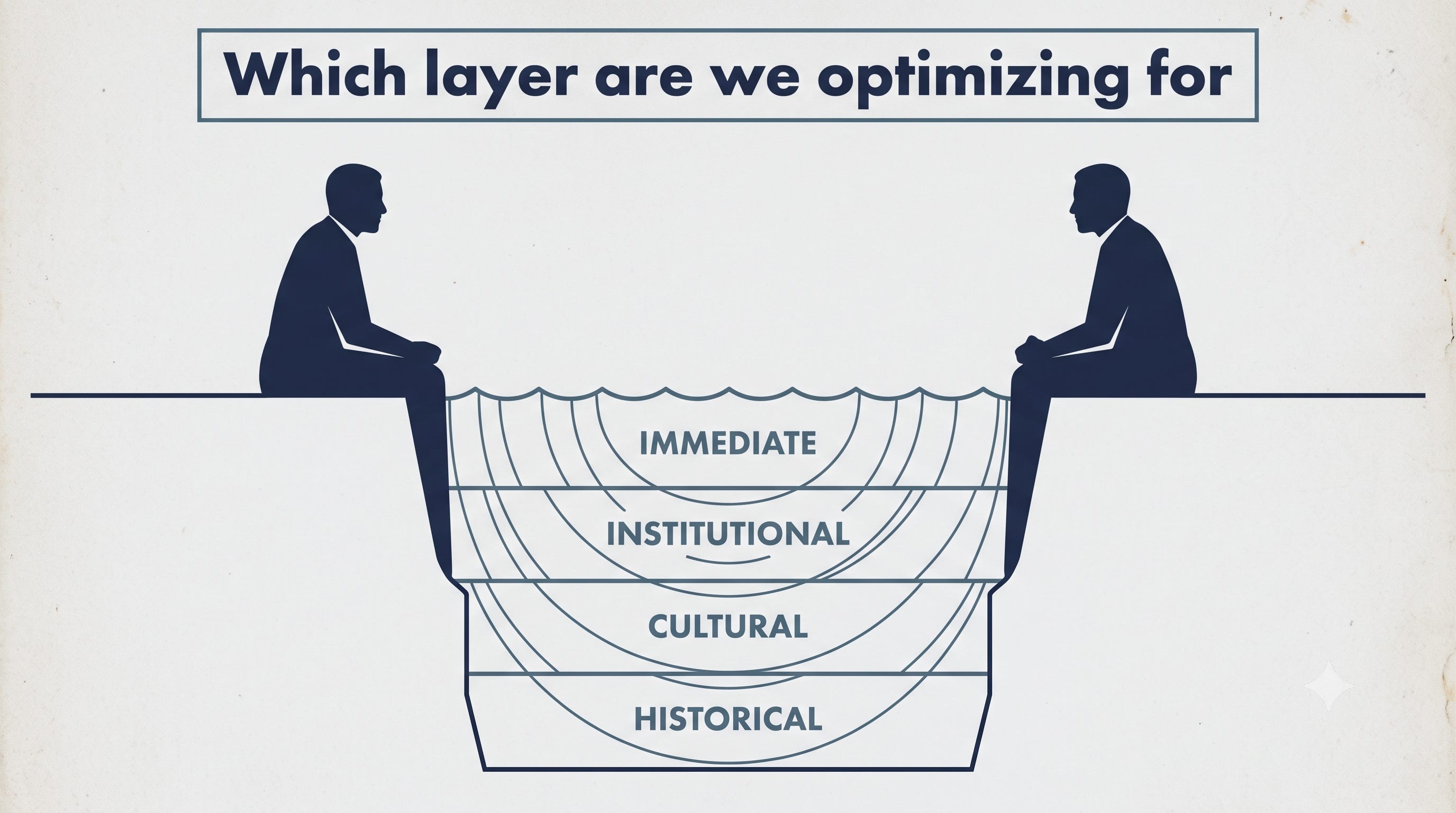
Then I put the lens to work immediately, before anyone could retreat into abstraction. Name a recent decision where you optimized for one layer and only later realized another layer was driving the outcome. Who did it land on differently than you expected? That one prompt does the work of both lenses at once: systems blindness and differential impact in a single move.
What surfaced across the rounds was that responsiveness is not a single virtue. When we asked whose signals each leader trusted most, the useful follow-up was never about the signal’s quality; it was whose experience produced this signal, and whose was structurally absent from it. At portfolio scale, the sensing apparatus becomes its own system, amplifying some voices and never registering others, and the leaders doing this well had learned to ask what their data was systematically quieter about, and what that silence meant. When we turned to the trade between standardization and local flexibility, the honest version of the question was not which one won. It was who benefited from the standard and who absorbed its cost, including the costs that never show up in a budget line, and Bronfenbrenner’s point landed hard: two leaders defending opposite choices were often just protecting different system layers, which says more about an organization’s real values than its stated ones. And when we asked which workplace orthodoxy the industry over-trusts, the sharpest version added a clause: whose reality does that metric fail to capture, and would have warned us sooner if we had been listening for it.
The through-line, and the line I closed on, was this. Adaptive workplaces are not built by responding faster. They are built by seeing more layers, and more people inside those layers.
The framework: developing the E in HEAL
Previously, I introduced a framework I have been building, called HEAL: Humanity, Equity, Acceptance, Love. It is not a model you will find in a textbook, and it is not widely known yet. It is the language I have built for something a lot of thoughtful leaders already practice without having a name for it, and my aim across this arc is to develop it one element at a time, slowly enough to do each one justice. This issue is the E.
Start from first principles, because Equity is the element most often flattened into something it is not. Equity is not equal treatment. Equal treatment gives every person the same response and calls that fairness. Equity gives a response calibrated to differential position and calls that fairness, because it begins from the fact that the same stone does not reach everyone the same way. In the language of signals: equity is the discipline of reading one signal as it lands differently across the water, and shaping the response around who is absorbing the cost rather than around who is easiest to see.

Two structural facts make this more than a slogan.
The first is that position is not additive; it compounds. Crenshaw’s original insight was that a person standing where two systems cross is not experiencing one disadvantage plus another. They are experiencing a distinct thing that neither single lens can see. The early-career employee absorbing a commute-cost decision may also be caregiving, also be on a visa, also be the first in their family to hold a professional role, and those do not stack into a taller pile. They intersect into a different pressure the surface signal will never show. A response calibrated to any one of those axes still misses the person standing at their intersection.
The second is that the cost travels through layers, not just across people. Optimizing the microsystem, the desk and the office and the collaboration you can watch, while ignoring the exosystem, the commute and the childcare and the second job, does not remove the cost. It relocates it, invisibly, onto whoever is positioned to absorb it quietly. Equity is therefore a multi-layer act of attention before it is ever a policy. You cannot distribute a cost fairly if you can only see the layer where you happen to be standing.
Here is why the element matters most in company with the other three, and how the four fail together when it goes missing.
When the framework holds whole, the elements reinforce each other. Humanity sees the person behind the metric rather than the metric itself. Equity sees that the signal from that person lands unevenly and calibrates the response accordingly. Acceptance treats the difference as legitimate rather than as something to be tolerated until it goes away. Love keeps the leader committed to the person’s flourishing even at the point where that commitment starts to cost. Together they turn the act of reading a signal into the act of reading a person inside their systems.
Pull Equity out, though, and watch the others curdle. Humanity without Equity becomes warm blindness: you see the individual in front of you vividly and with real care, and you still miss that the system meets them on terms it never set for you, and you have no attention left over for the person who already left. Acceptance without Equity tolerates difference while leaving its cost sitting on the same shoulders: you permit the accommodation and still quietly let the person pay for having needed it. Love without Equity is care that never redistributes anything: genuine warmth that still lets the least-protected absorb the losses, because love that never asks who pays is only comfortable for the person offering it. And Equity failing on its own has its own signature failure, the one to watch for most: without Humanity beside it, Equity collapses into demographic accounting, a scoreboard of categories where the representation numbers move and not a single person’s lived experience changes.
The deepest point is that all four elements fail in the same direction, and it is the direction the four weekly signals were pointing at all along. A leader optimizes for the layer and the population closest to them. The performance misread was that failure at the level of one person: your frame, not their circumstance. The frozen label was that failure over time: your category, not their range. The empty response was that failure in action: your comfort, not their cost. The silent channel was that failure in what you never heard: your survivors, not their exit. Equity is the element whose entire job is to interrupt that direction, to pull attention off the nearest layer and the loudest survivor and toward the person the signal reached first and hardest, and quietest.
Practice of the Month: a ripple check
Before you act on any signal that carries real stakes, run it through three moves. None of them slows a decision much. All of them keep the map from replacing the lake.
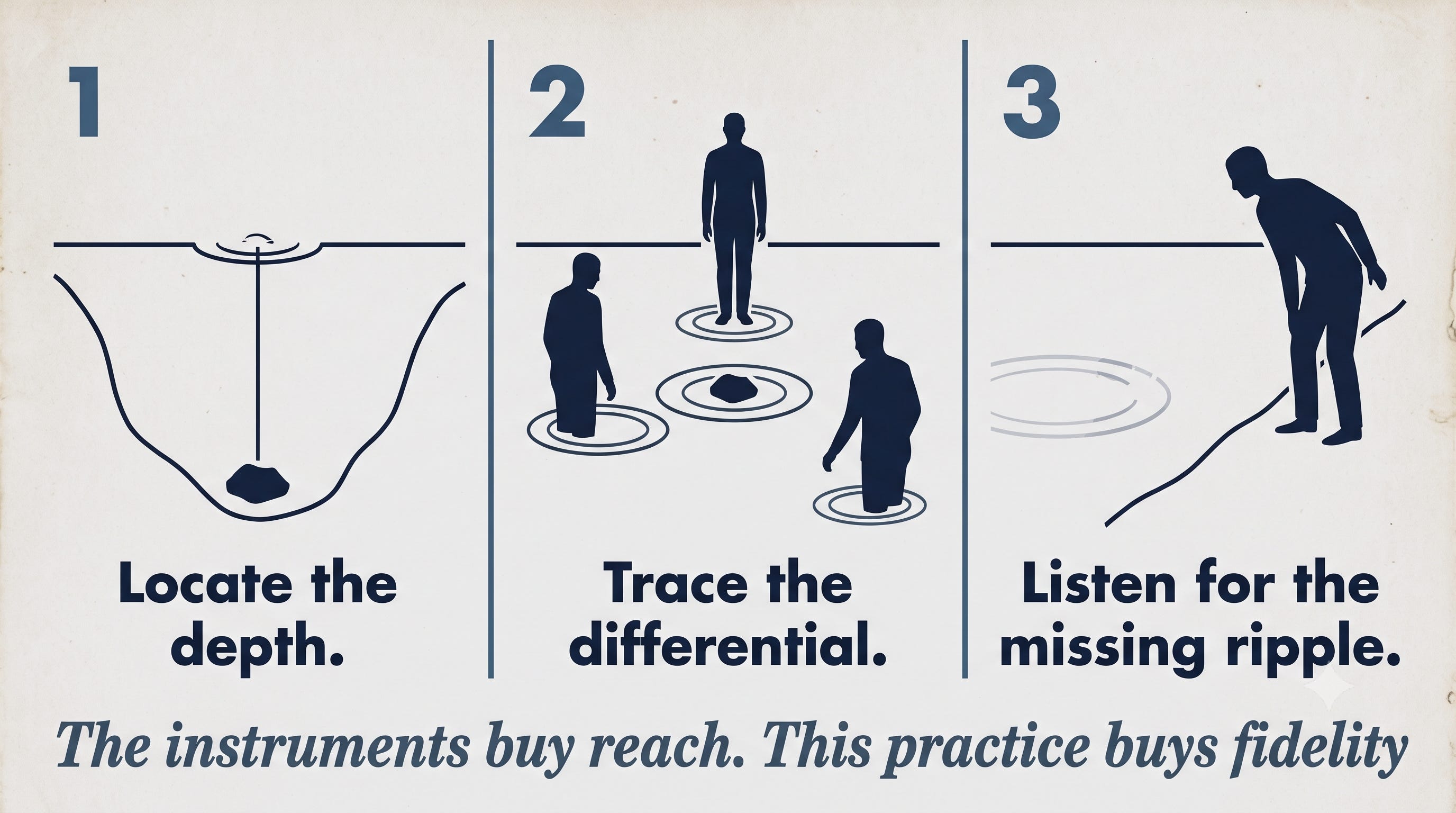
Locate the depth. Before you name what a signal means, name which layer it reached you through and which layer most likely produced it. The missed deadline reached you through the microsystem of your team; it may have been made in the outer ring of a life you cannot see. The gap between where a signal arrives and where it originates is usually the whole story, and naming that gap out loud is often enough to stop a wrong conversation before it starts.
Trace the differential. Take the specific decision in front of you and name three differently positioned people it touches. For each, ask honestly whether this lands as a lap or as a wave. If you find you cannot picture three genuinely distinct people, that difficulty is not a detail to move past. It is the finding. It means your read of the workforce is running on a single default person, and the default person is almost always the one who looks like the room where the decision gets made.
Listen for the missing ripple. Ask who used to show up in this signal and no longer does, and whether their absence is agreement or exit. Then, before you act, go and get one of those missing readings directly. One conversation with a person the instrument stopped hearing will tell you more than another pass through the instrument ever will.
The instruments buy you reach. Only this buys you fidelity.
Reader question
Think of a workplace decision you are confident landed well. Whose ripple were you positioned to feel, and whose simply had not reached your shore yet?
Theory Reference
The scaffolding under this issue is Urie Bronfenbrenner’s ecological systems theory, first set out in the late 1970s. He proposed that development and behavior can only be understood inside a set of nested environments. The microsystem is the immediate setting a person acts in day to day. The mesosystem is the interaction between those settings. The exosystem is the layer a person does not directly inhabit but is shaped by anyway, a partner’s work, a school schedule, a transit system, a budget decided elsewhere. The macrosystem is the surrounding cultural, economic, and ideological pattern. And the chronosystem is the dimension of time and historical moment, the reason a decision made in one year lands differently than the same decision made in another. His central claim, and the one that matters for signals, is that these layers operate simultaneously, and that we consistently mistake the layer we can see for the layer that is actually driving the outcome.
Kimberlé Crenshaw’s work on intersectionality supplies what Bronfenbrenner’s model alone does not: an account of why those layers do not press evenly on a population. Analyzing legal cases in which Black women fell through the gap between race discrimination and sex discrimination because the law would only look down one axis at a time, Crenshaw showed that single-axis thinking does not merely undercount disadvantage. It renders the people standing at the intersection invisible, because their experience is not the sum of two familiar categories but a distinct thing neither category was built to see. Laid over Bronfenbrenner, the implication is direct. The same nested systems produce different lived realities depending on where in them a person stands, and the intersections are exactly the positions a leader’s instruments are least equipped to register.
The four cognitive mechanisms behind the month’s editions are best understood as the specific distortions that decide which ripples a leader ends up reading. The fundamental attribution error, described by Lee Ross in 1977, biases us toward dispositional readings of behavior and away from situational ones, so a capacity problem gets read as a performance problem. Social categorization, traced from Gordon Allport through the review work of Macrae and Bodenhausen, explains how an activated label goes on to shape what we notice, how we interpret ambiguity, and what we remember, so a working guess quietly becomes a verdict. Loss aversion, from Kahneman and Tversky’s prospect theory, explains why a response that costs something felt loses by default to a response that only looks like action. And survivorship bias, with the organizational-silence research of Morrison and Milliken alongside it, explains why the voices a channel drops are disproportionately the departing, the junior, and the already-discouraged, which are precisely the voices a leader most needs and least hears. Each mechanism is a reason the water reaches you pre-filtered. Equity is the discipline of reading against the filter.
Further Reading
Books
Bronfenbrenner, U. (1979). The ecology of human development: Experiments by nature and design. Harvard University Press.
Kahneman, D. (2011). Thinking, fast and slow. Farrar, Straus and Giroux.
Banaji, M. R., & Greenwald, A. G. (2013). Blindspot: Hidden biases of good people. Delacorte Press.
Shorter reads
Bronfenbrenner, U. (1977). Toward an experimental ecology of human development. American Psychologist, 32(7), 513–531. https://doi.org/10.1037/0003-066X.32.7.513
Crenshaw, K. (1991). Mapping the margins: Intersectionality, identity politics, and violence against women of color. Stanford Law Review, 43(6), 1241–1299. https://doi.org/10.2307/1229039
Crenshaw, K. (1989). Demarginalizing the intersection of race and sex: A Black feminist critique of antidiscrimination doctrine, feminist theory and antiracist politics. University of Chicago Legal Forum, 1989(1), 139–167.
Ross, L. (1977). The intuitive psychologist and his shortcomings: Distortions in the attribution process. In L. Berkowitz (Ed.), Advances in experimental social psychology (Vol. 10, pp. 173–220). Academic Press.
Macrae, C. N., & Bodenhausen, G. V. (2000). Social cognition: Thinking categorically about others. Annual Review of Psychology, 51, 93–120. https://doi.org/10.1146/annurev.psych.51.1.93
Kahneman, D., & Tversky, A. (1979). Prospect theory: An analysis of decision under risk. Econometrica, 47(2), 263–291.
Morrison, E. W., & Milliken, F. J. (2000). Organizational silence: A barrier to change and development in a pluralistic world. Academy of Management Review, 25(4), 706–725. https://doi.org/10.5465/amr.2000.3707697
Practice of Thinking is the monthly companion to Theory Meets Tuesday from Unified Purpose. Monthly reflections on leadership practice. Replies are read.