


Issue 006 · November 2026
Why this month
Every leadership conversation about AI this fall is a conversation about pace, and almost nobody is having it that way. The questions on the agenda are destination questions. Which model? Which vendor? Which agent platform? What goes on the strategy slide for the board? The destination is the easy part. The hard part is what happens between the license and the Tuesday afternoon when someone has to check forty AI-drafted responses before they go out the door.
Look at your own calendar. The vendor renewal lands in December. The board wants the AI slide in January. Somewhere in between, a team has quietly stopped opening the new tool, and a manager is reviewing machine output at five o’clock on a Friday because nobody else was assigned to do it. None of that shows up on the adoption dashboard. All of it decides whether the investment works.
This is the same material every change you have led was made of: fixed dates, multiple teams, costs that land on people the plan never named. AI adds one new twist. The technology now changes faster than any adoption curve can follow, so the gap between what you could enable and what your people can absorb widens every quarter, whether you act or not.
This month, the protocol I have been building comes together in one place and gets aimed at that gap. One idea, one scenario, and one four-week practice you can run on a live initiative.
The distinction: deployment is not absorption
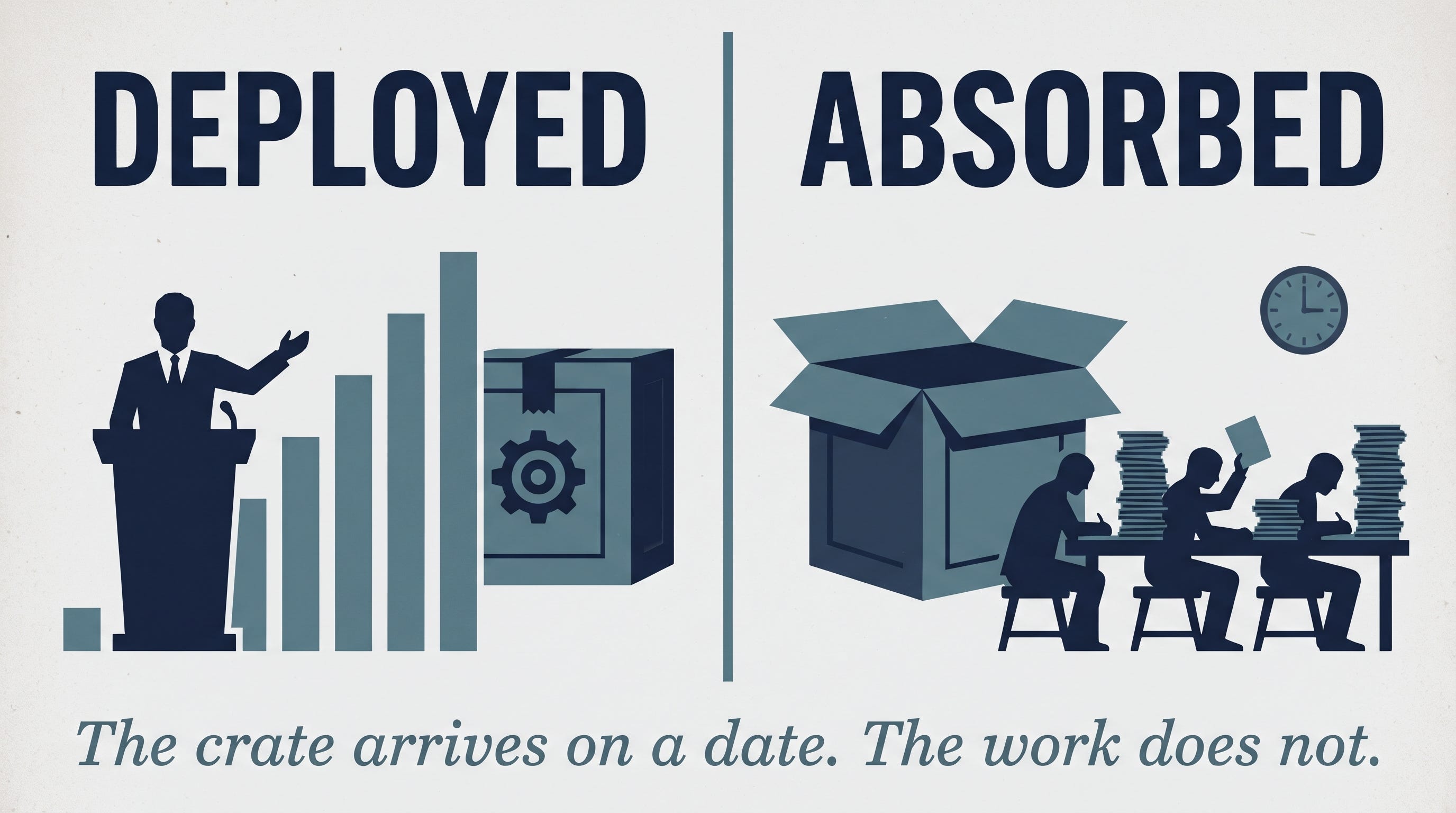
Deployment is a purchasing event. Absorption is a redesign of how work gets done, who checks it, and who carries the load when the tool is wrong. Organizations count the first because it produces a number on a date. The second produces no number and has no date, so it waits. When it waits long enough, the tool gets blamed for a failure that was never technical.
That gap is now measurable. Deloitte’s 2026 enterprise AI research found that worker access to AI tools grew by about half in a single year, from under 40 percent of workers to roughly 60 percent. Fewer than 60 percent of those with access use it in their daily work, and 84 percent of organizations have not redesigned jobs or workflows around it. The organizations bought access. The workflows, and the people inside them, were left to absorb the rest.
Three forces specific to this moment push the gap wider.
Volume. Gartner projects the average Fortune 500 company will run more than 150,000 AI agents by 2028, up from fewer than 15 in 2025. It separately projects that more than 40 percent of agentic AI projects will be scrapped by the end of 2027. Those are projections, not measurements. The direction is what matters: the number of things you could enable now exceeds any organization’s capacity to sequence them.
Cognitive load. A BCG team surveyed 1,488 U.S. full-time workers and found that 14 percent of AI users reported a specific mental fatigue from heavy use or oversight of AI tools, which the researchers named “AI brain fry.” It was associated with more errors, more decision fatigue, and stronger intention to quit. The most taxing pattern was not using AI. It was overseeing it. These are survey associations, not proof of cause, and they still tell you something your license report never will: the cost of AI now shows up in people’s heads.
A split view. Asana surveyed more than 4,500 leaders and workers in the U.S. and U.K. and found that 68 percent of leaders use three or more AI agents weekly, against 36 percent of workers. Nearly half the workers using agents said they spend about a tenth of their working time switching tools, choosing which agent to use, or reconciling conflicting outputs. The research is vendor-sponsored, so read the numbers as directional. The question it raises stands on its own: leaders and the people they lead may not be looking at the same workplace.
Underneath all three is the response-mode trap. Vendor cycles, model releases, and competitor announcements arrive faster than an organization can process them. That keeps leaders reacting and makes design feel like a “nice-to-have”. Grossman Group research with The Harris Poll found that most employees say they can realistically absorb one or two major changes a year, while more than half of business leaders expect to implement three or more over the next two years. The time horizons differ, so the gap is directional rather than arithmetic. The claim I can defend is simpler: whatever your organization’s true absorption rate, AI multiplies the changes competing for it.
So here is the claim for this issue. PACE turns AI enablement from a rollout target into a set of decisions: what to enable, whose evidence matters, who carries the costs, and what must remain owned after launch.
Four lenses: PACE as a decision, not a checklist
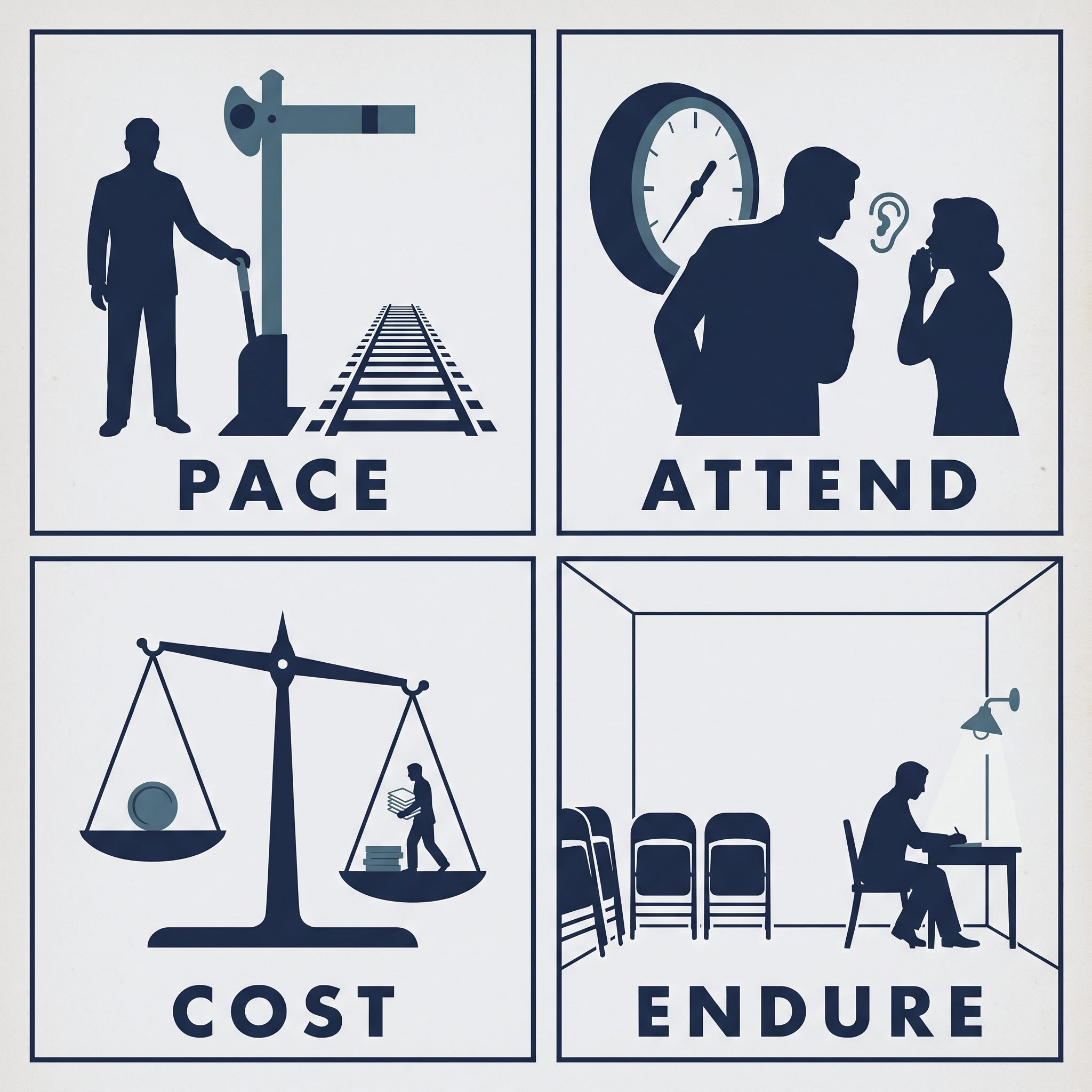
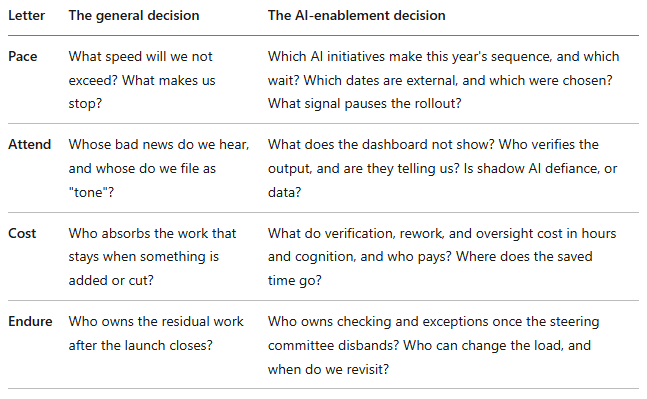
PACE is the working protocol I have been building alongside HEAL, a leadership framework of mine that isn’t widely known yet. HEAL names the commitments. PACE turns them into decisions a leader actually has to make: Pace, Attend, Cost, Endure.
Pace: what speed will we not exceed?
Urgency is a label, and AI roadmaps wear it well. A vendor’s release cycle comes with a date. Absorption capacity and oversight design come with none, so they lose every scheduling argument they are never invited to. Pace forces a sequencing decision: which AI initiatives make this team’s list this year, which wait, and which dates are genuinely external (a regulation, a contract renewal) versus chosen because speed felt like strategy. Then comes the part leaders skip. What signal stops or pauses a rollout? A stop condition written in advance gives the invisible costs a finish line.
Pace also governs how people learn. Most AI pilots demand deliverables before anyone has explored what the tool is for. The result is compliance dressed as curiosity: demo-driven usage numbers instead of discovery. The better sequence is a protected exploration window with no promised output, then a bounded trial with real feedback, with the point where evaluation begins named in advance. That is a Pace decision applied to learning.
Attend: whose bad news do we hear?
The adoption dashboard is the purest signal trap a leader can own. License counts and activity metrics can rise while honesty about the tools falls. Attend asks what the dashboard cannot show. Who verifies the AI output, and are they telling you what they find? When leaders and workers use these tools at such different rates, whose reports are actually reaching you? And where people are using unsanctioned tools, is that defiance, or data that the sanctioned ones are losing?
Cost: who absorbs the work that stays?
Every AI efficiency slide shows the visible ledger: licenses, hours saved, headcount avoided. The absorbed ledger stays off the slide. Verification, rework, exception-handling, and oversight are real work, done by specific people, paid in hours and evenings and attention. The brain-fry research gives that ledger a new unit of measure: cognition. Cost asks two questions. Who pays for the checking, by name? And is the time AI saves coming back to the person who saved it, or being converted into more output of the same kind?
Endure: who owns the residual work after launch?
The pilot closes green. The steering committee disbands. The checking, the exception-handling, and the job of teaching the new workflow to the next hire stay with people the plan no longer counts. Psychologists call this a post-completion error: once the main goal is met, the cleanup step is the one that gets dropped. AI rollouts produce it reliably. Endure asks who owns that residual work, with what protected time, and with what authority to change the load when it grows.
Before any letter: check the clocks
One more lens runs across the whole protocol. An AI transformation runs on a shared clock: board expectations, vendor cycles, the hype calendar. Your people run on their own. One colleague remembers the last rollout that failed. Another is counting this week’s open roles. The leader is counting next year’s return. Same deadline, different clocks. Before announcing anything, run a five-minute Timeline Check, and treat it as PACE’s step zero. It is finished only when it changes something: timing, sequencing, support, or review conditions.
PACE at a glance
The budget-line version
McKinsey’s research on agentic adoption finds that organizations succeeding with AI spend roughly $1 on the technology, $3 on process redesign, and $5 on capability building and adoption. Read that ratio again with PACE in hand. It is the protocol expressed as a budget. The leaders getting value from AI are not the ones deploying fastest. They are the ones spending most of their money on the parts of the change PACE governs.
Theory in Practice: one pilot, four decisions
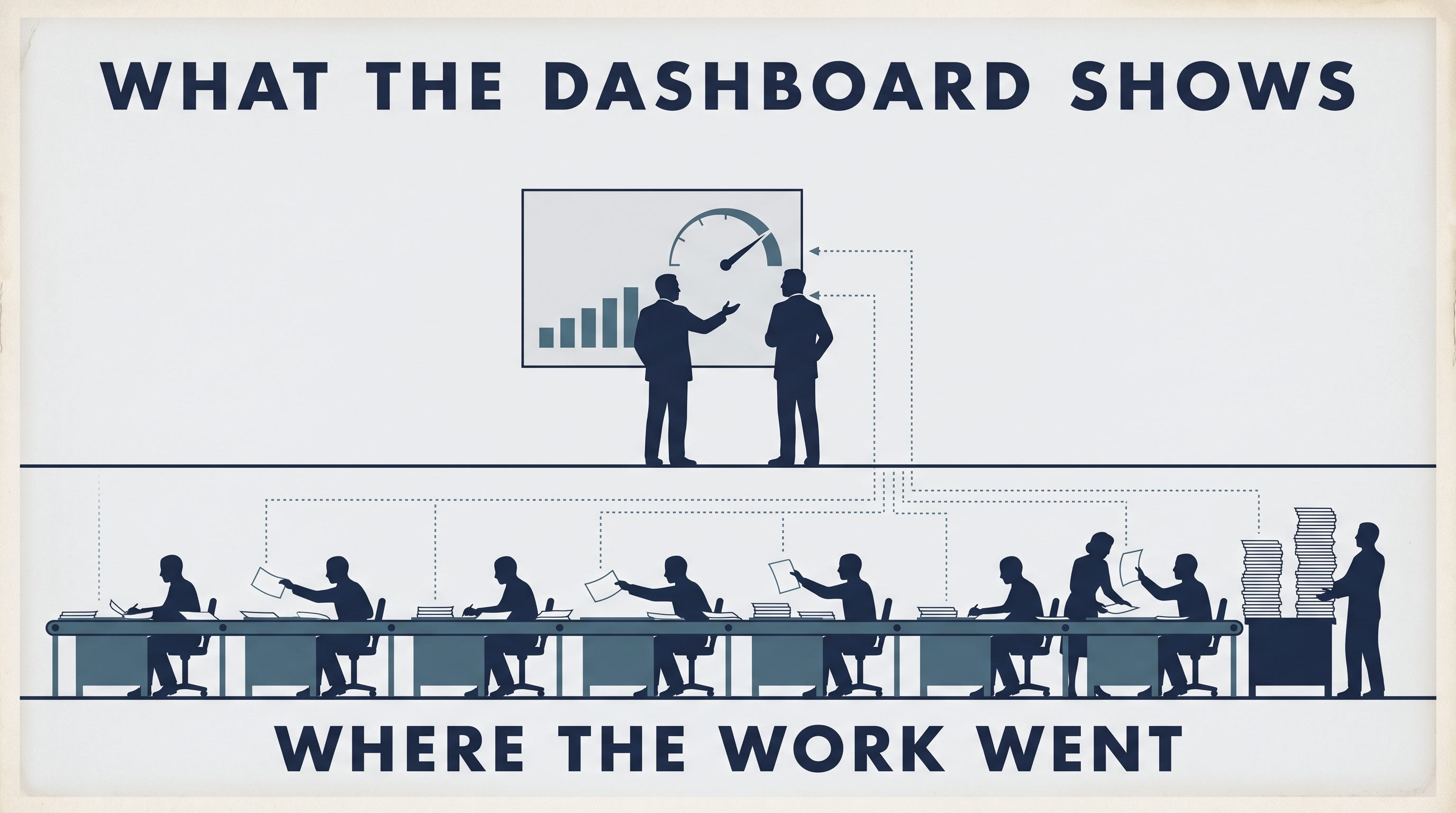
This is a composite scenario built from patterns common to support organizations. It is not one company’s story.
A customer-support director, call her Dana, runs six teams. Two of them have spent a quarter piloting AI-assisted triage. The system classifies incoming tickets and drafts a first response, and agents review and send. The pilot dashboard is green. Draft time is down sharply. Adoption in the two pilot teams is near total. The steering committee wants a decision at the quarterly review, and the proposal on the table is to expand to all six teams.
The proposal treats expansion as the obvious next step. PACE treats it as one of four options: expand, continue the trial, redesign the workflow, or pause. Then it asks what evidence would choose among them.
Pace asks what else the four remaining teams are absorbing this year. Two of them are halfway through a ticketing-system migration. One just lost its lead. Expanding to all six in one quarter would land on teams already at their limit. Pace also asks what stops the rollout once it starts: a quality threshold on reopened tickets, a workload ceiling for reviewers, a trust signal the team agrees on in advance.
Attend asks what the dashboard leaves out. Dana asks three reviewers directly. They tell her the draft speed is real, but about one draft in five needs a substantial rewrite, and two of the strongest agents have stopped flagging bad drafts because flagging “looks like resistance.” The quietest reviewer turns out to be the one doing the most correction.
Cost asks who absorbs that rewriting, by name. The answer is the senior agents, the people Dana can least afford to burn out. The pilot did not remove work. It moved work from drafting to checking, and from junior staff to senior staff. The efficiency slide counted only the first half of that sentence.
Endure asks who owns the checking after the pilot formally closes. Nobody does. The pilot lead is rotating back to her old role. The exception queue has no owner and no review date.
Dana does not expand to six. She redesigns. Review becomes a named role with protected time on each team. Rewrite rate becomes a tracked metric alongside draft speed. Expansion goes to two more teams, the ones not mid-migration, with stop conditions written into the plan and a review date set before launch, while changing course is still cheap. The committee gets a decision with named evidence instead of a status update.
None of the four letters said no to AI. Each one made the decision more honest.
HEAL: Humanity
I’ve built a framework called HEAL around four commitments: Humanity, Equity, Acceptance, and Love. It isn’t widely known yet. I’m developing it in public, one commitment at a time, and PACE is the working protocol that lets those commitments survive contact with a calendar. AI enablement tests Humanity more directly than any change I have written about this year.
Here is the mechanism. Humanity, in HEAL, is the commitment to treat people as the point of the work rather than an input to it. Every enablement plan makes a quiet claim about where the person sits. In one kind of plan, the person is the bottleneck the tool removes. In the other, the person is the judgment the tool serves. Those two plans can buy the same license, run the same pilot, and report the same adoption number. They produce different organizations.
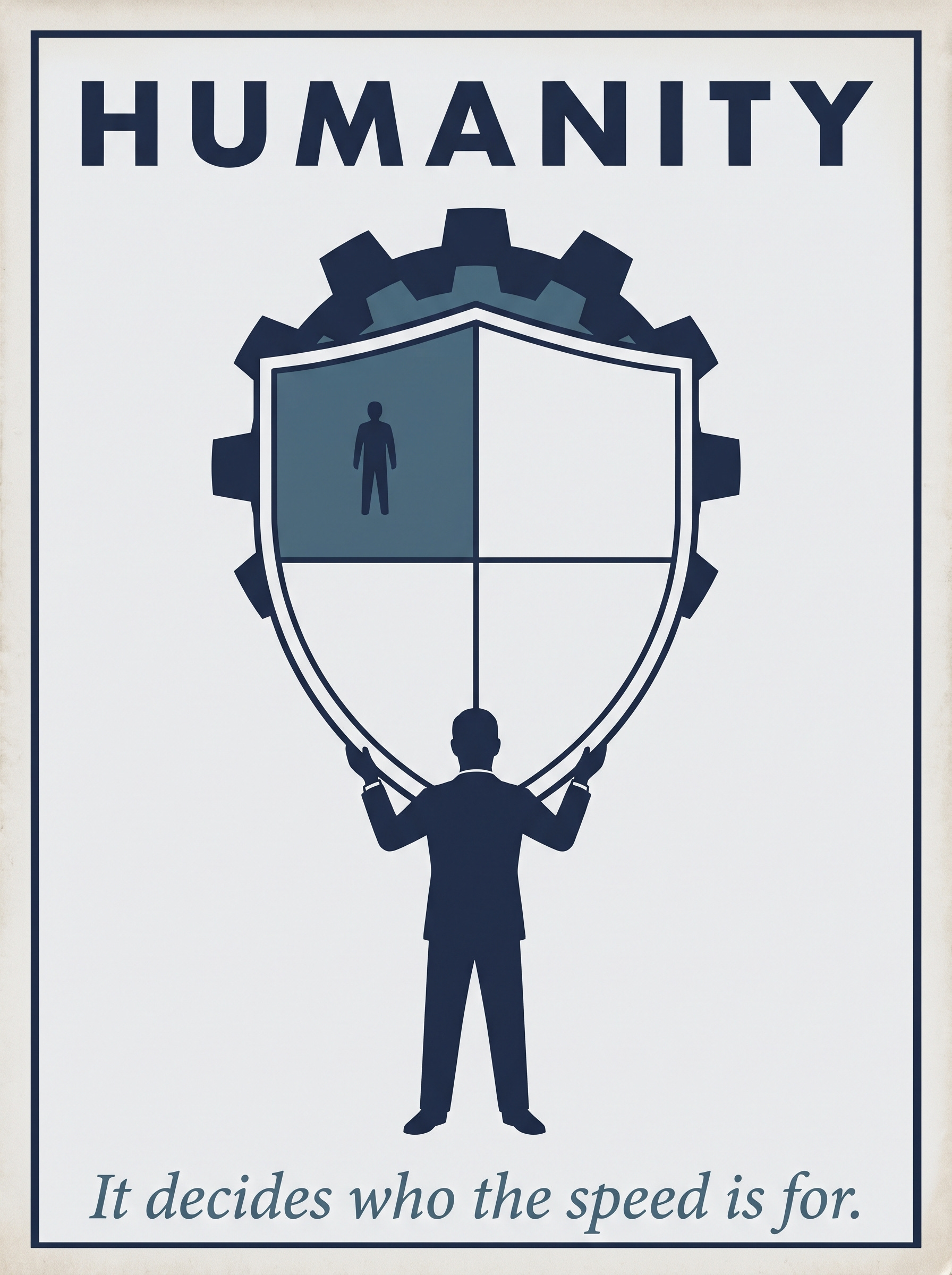
The evidence points the same way. The brain-fry research found that when AI took routine tasks off people’s plates, burnout scores were lower, not higher. The exhaustion came from oversight layered on top of existing work, not from AI itself. The variable is not how much AI people use. It is how the work around the AI is designed, and whether that design was done with the person in view.
That is why Humanity has to come before the rollout target, not after the engagement survey. A leader who treats reviewers as a cost to minimize will read rising correction work as a performance problem. A leader who treats reviewers as the judgment the system depends on will read the same numbers as a design problem, and fix the design. The first leader optimizes the tool. The second builds an organization that can use it.
Humanity does not slow AI down. It decides who the speed is for.
Practice of the Month: the PACE Decision Cycle
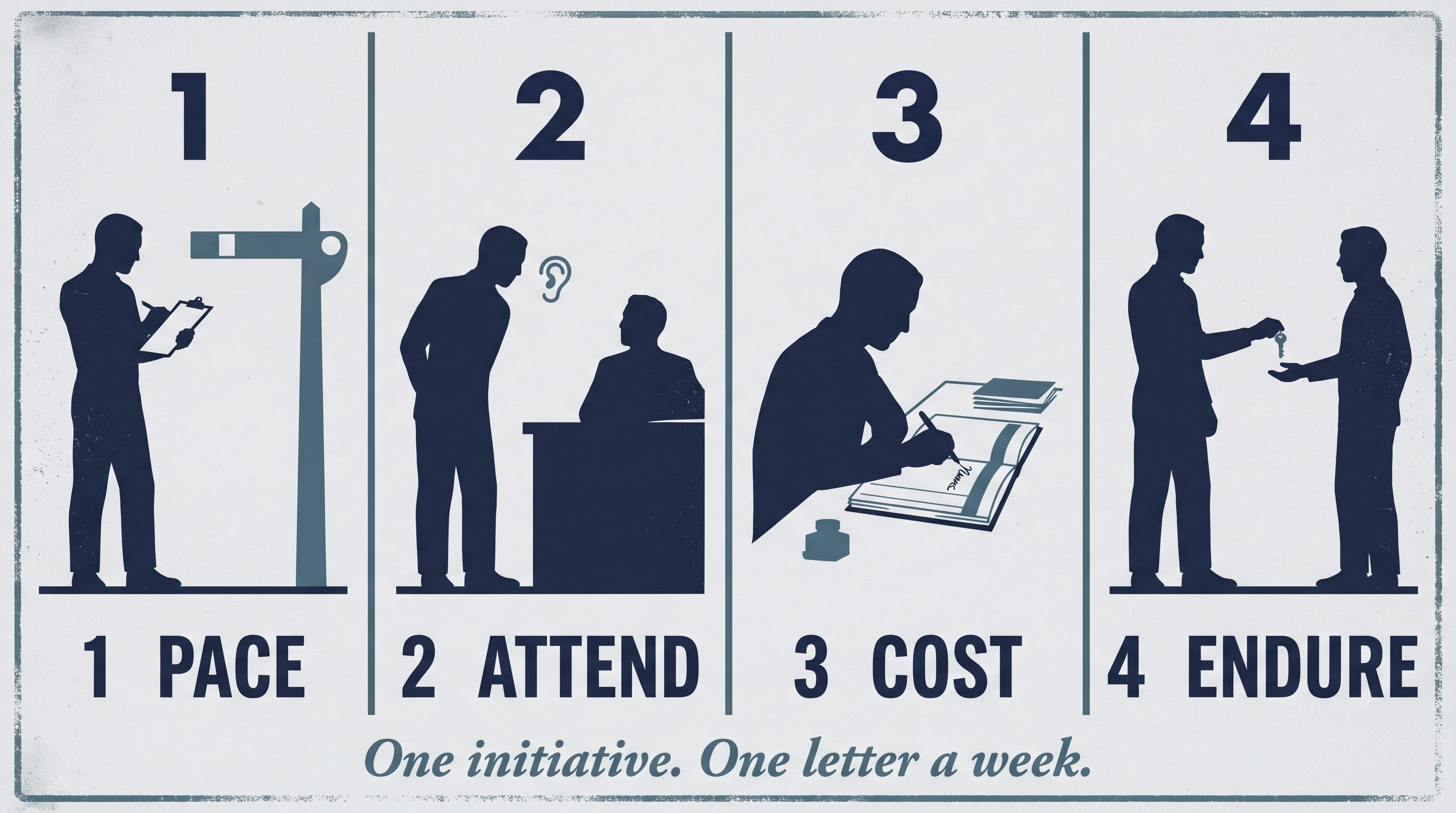
Pick one AI initiative, live or planned: a tool rollout, an agent pilot, a workflow automation. Give each week to one letter. By the end of the month you will have a recorded decision instead of momentum.
Before you start: the Timeline Check. Five minutes, before anything is announced. What came before: the last rollout this team remembers? What is happening now: capacity, vacancies, workload? What happens next, and who carries it? Why this deadline: external, or chosen? When will you reconsider? Don’t move on until the check produces one concrete change to timing, sequencing, support, or review conditions.
Week one: Pace. Write the stop conditions before the next steering meeting: one workload limit the team will not cross, one quality signal you will not ignore, and one trust signal you will watch for, such as the two people who go quiet. Sequence this initiative against everything else these specific teams are absorbing this year. Separate real deadlines from chosen ones. Then shape the learning: a protected exploration window with no promised output, followed by a bounded trial, with the point where evaluation begins named in advance.
Week two: Attend. Ask three people who touch the AI output every day one question: “What does the dashboard not show?” Credit the messenger before you judge the message. Treat unsanctioned tool use as information about the sanctioned ones.
Week three: Cost. Fill in two ledgers. The visible one holds licenses, budget, and hours saved. The absorbed one holds verification, rework, exception-handling, and how much concurrent oversight and tool-switching each role carries. Put a name next to every line of the absorbed ledger. If you can’t name who pays, the pace isn’t approved. It’s deferred.
Week four: Endure, then decide. Map the residual work: who checks outputs, who handles exceptions, who teaches the workflow to the next person. Give that work an owner, protected time, a review date, and the authority to change the load. Then record the decision (expand, continue the trial, redesign, or pause) with a named decision-maker and a short written rationale.
One rule holds across all four weeks. If a week’s deliverable can’t be completed, that isn’t a failure. It’s the finding. It marks a decision nobody has made yet, and that decision needs making before you expand.
A question for you
Which AI initiative are you about to speed up, and which letter of PACE are you most tempted to skip?
Hit reply and tell me. If you run the cycle this month, tell me what week three turned up. The cost ledger is where the honest conversations live.
Theory Reference
The argument of this issue sits where two research traditions meet, and they rarely speak to each other.
The first is about an organization’s capacity for change. James March’s 1991 paper on exploration and exploitation showed that organizations balance two kinds of learning. Exploitation refines what they already do. Exploration searches for what they could do. Exploitation pays faster and more reliably, so it steadily crowds out exploration unless someone deliberately protects it. An AI pilot that demands deliverables in its first week is that dynamic in miniature. More recent practitioner research from David Grossman and The Harris Poll adds the human ceiling: employees report they can absorb only a small number of major changes in a year, while leaders plan for more.
The second tradition is about cognitive capacity. Michael Byrne and Susan Bovair’s 1997 work on post-completion error showed that once a task’s main goal is satisfied, the cleanup steps that follow are the ones people drop, especially under working-memory load. George Loewenstein’s 1996 account of visceral influences on behavior explains why people in a calm state consistently underestimate how strain will shape their decisions later, the gap between cold planning and hot execution. Leaders design rollouts from the cold side of that gap and misjudge what oversight will feel like from the hot side. The 2026 brain-fry study by Julie Bedard, Gabriella Rosen Kellerman, and colleagues brings both threads into AI: the cognitive cost concentrates in oversight, not use, and when AI removes routine work instead of piling onto it, burnout falls.
Joining these two traditions is my proposed synthesis, not an established finding. AI enablement struggles where initiatives are paced as if organizational capacity were unlimited and counted as if oversight were free. PACE is the bridge. Pace and Attend manage the absorption side. Cost and Endure make the oversight side visible and owned.
Further Reading
Books
March, J. G. (1994). A primer on decision making: How decisions happen. Free Press. March’s full account of how decisions actually get made inside organizations, including the exploration and exploitation trade-off that sits under the Pace letter.
Mullainathan, S., & Shafir, E. (2013). Scarcity: Why having too little means so much. Times Books. The clearest book-length case that limited bandwidth changes how people decide. Read it as the cognitive side of the Cost ledger.
Short reads
Bedard, J., Kropp, M., Hsu, M., Karaman, O. T., Hawes, J., & Kellerman, G. R. (2026, March 5). When using AI leads to “brain fry.” Harvard Business Review. https://hbr.org/2026/03/when-using-ai-leads-to-brain-fry The research that gives the Cost letter a cognitive unit of measure.
Byrne, M. D., & Bovair, S. (1997). A working memory model of a common procedural error. Cognitive Science, 21(1), 31–61. https://doi.org/10.1207/s15516709cog2101_2 Why the cleanup step is the one that disappears. The research behind the Endure letter.
Deloitte. (2026). AI adoption to AI adaptation. Deloitte Insights. https://www.deloitte.com/us/en/insights/topics/talent/ai-adoption-to-ai-adaptation.html The access-versus-use numbers, plus a useful reminder that adoption is easy to prove and easy to fake.
Grossman, D. (2026). When employees are drowning in change. MIT Sloan Management Review. https://sloanreview.mit.edu/article/when-employees-are-drowning-in-change/ Change-capacity research written for leaders rather than academics. Grossman’s emphasis on sequencing reads like a cousin of the Pace letter.
Loewenstein, G. (1996). Out of control: Visceral influences on behavior. Organizational Behavior and Human Decision Processes, 65(3), 272–292. https://doi.org/10.1006/obhd.1996.0028 Why the plan written in a calm conference room misjudges the Friday afternoon it creates.
March, J. G. (1991). Exploration and exploitation in organizational learning. Organization Science, 2(1), 71–87. https://doi.org/10.1287/orsc.2.1.71 The original paper on why the sure thing crowds out discovery.
McKinsey & Company. (2026). How to close the agentic adoption gap. https://www.mckinsey.com/capabilities/people-and-organization/our-insights/how-to-close-the-agentic-adoption-gap The 1:3:5 ratio: the budget-line version of this whole issue.
Practice of Thinking is the monthly companion to Theory Meets Tuesday from Unified Purpose. Monthly reflections on leadership practice. Replies are read.