


Issue 002 · July 2026
The framework problem
Most leadership frameworks are additive. Learn this skill, add this practice, develop this habit. The implicit promise is that each element makes you a marginally better leader, and the elements do not particularly interfere with each other.
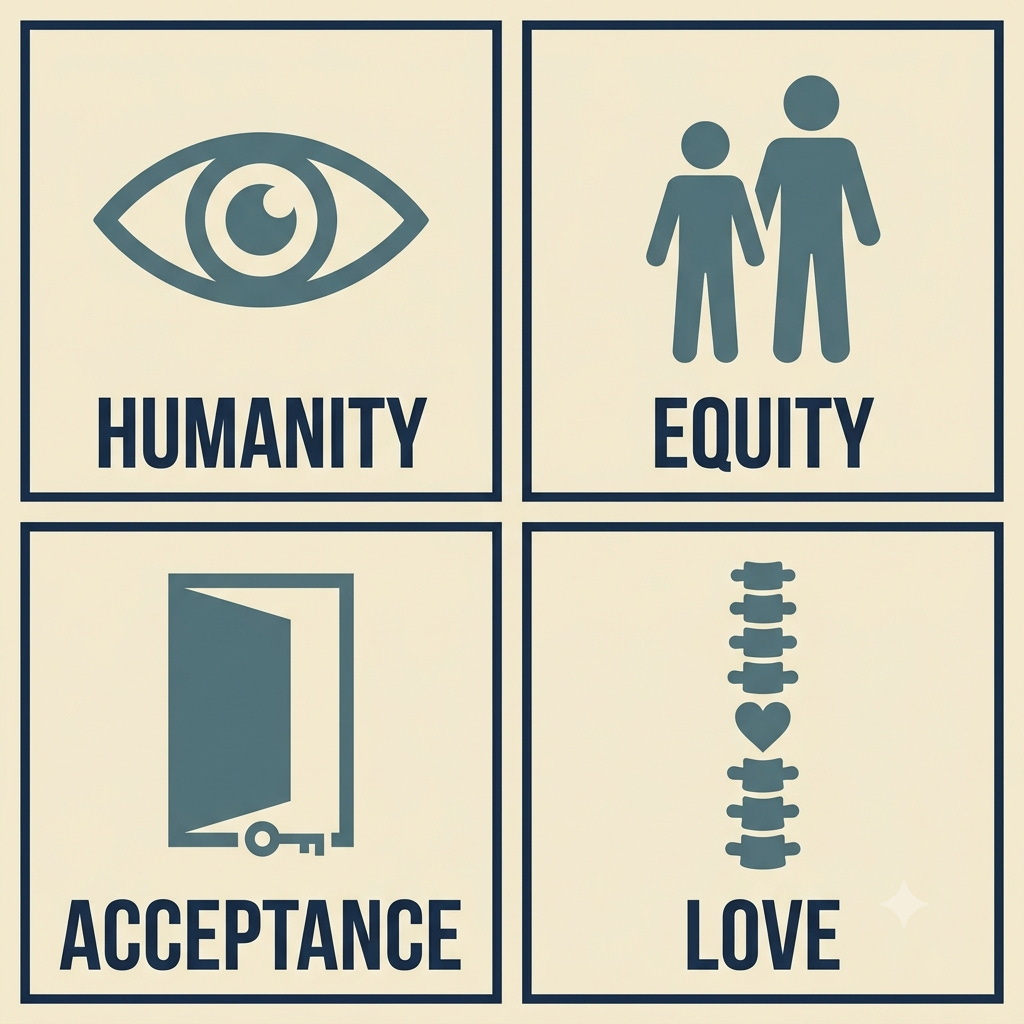
HEAL is not built that way. Its four elements, Humanity, Equity, Acceptance, and Love, are interdependent in a specific and unforgiving sequence. Each one creates the conditions the next requires. Which means that a failure in any one of them does not just limit that element. It corrupts everything downstream.
This month’s work moved through each element in sequence. What follows is the deeper account: what each capacity actually demands at the individual level, and what happens at the team and organizational level when the four are held together, held apart, or held in the wrong order.
Humanity: the atrophy problem
The central claim of Humanity in the HEAL framework is not that leaders should be warmer or more emotionally present. It is something more specific and more uncomfortable: certain kinds of human attention are irreplaceable, and irreplaceable things can be lost through disuse.
The relevant research here is on automation bias, the documented tendency first described by Mosier and Skitka in the context of aviation, to use an automated cue as a heuristic replacement for vigilant information-seeking and processing (Mosier & Skitka, 1996). The finding that made this research matter beyond the cockpit is the relationship between system reliability and error rate. Pilots working with highly accurate automated systems made more errors in certain conditions, not fewer. Not because the systems failed, but because their reliability made continued human vigilance feel unnecessary. The more you could trust the output, the less you checked it.
Two error types emerged from this pattern. Commission errors occur when a pilot follows an incorrect automated recommendation even when other instruments contradict it. Omission errors occur when a pilot fails to notice a problem the system does not flag. Both are failures of attention, but they operate through different mechanisms. Commission errors are about over-deference. Omission errors are about the gradual shrinkage of the domain a leader actively monitors: the quiet retirement of questions that used to get asked.
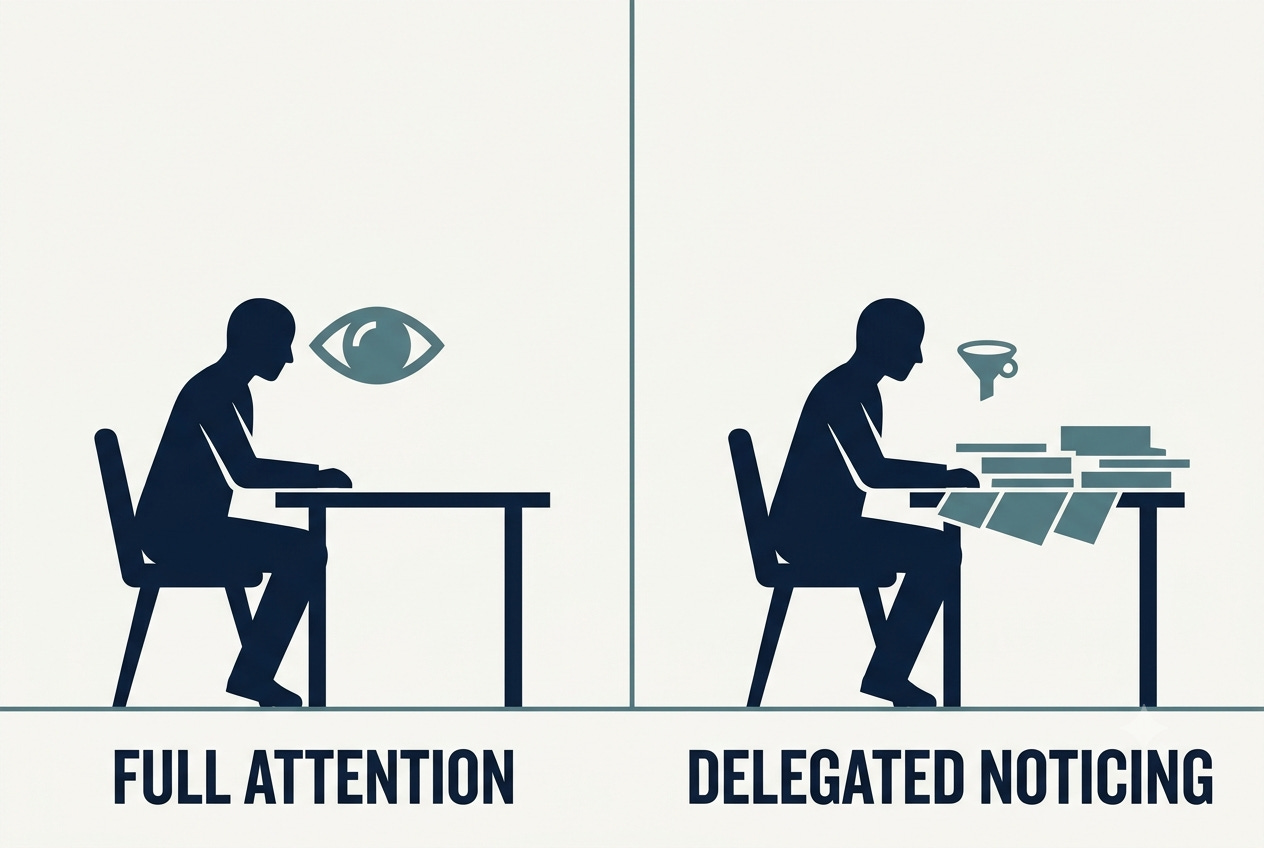
The leadership implication is not about technology. It is about any system that reliably produces plausible outputs, whether meeting summaries, performance dashboards, synthesized recommendations, or pre-drafted responses. When a leader delegates noticing to a process, they are making a bet that the process notices what they would have noticed. That bet is usually close to right. When it is wrong, the failure is invisible until it is not. And the capacity to catch it atrophies in the meantime.
Humanity, understood through this lens, is the practice of protecting domains of active attention. Not everything, because that would be paralyzing. But specific domains: the ones where the texture of a conversation, the hesitation in a response, the thing someone almost said, is the actual data. These are the domains where speed and delegation produce something that looks like leadership but functions as its absence.
The individual-level practice is deliberate. The question is not whether to use efficient systems. It is which parts of the work you are intentionally protecting from them, and whether that boundary is explicit or simply eroding.
Equity: the filtration problem
If Humanity is about protecting the capacity to notice, Equity is about expanding the range of what gets noticed. The failure mode here is subtler than it looks.
Most leaders who create unequal hearing environments are not trying to. They are using cognitive shortcuts that feel like judgment and function like filtration. The mechanism was formalized in research by Wang and colleagues in 2003 through the Scale of Ethnocultural Empathy (SEE), which identifies empathic perspective-taking as a distinct and measurable capacity: the ability to genuinely inhabit another person’s frame without collapsing it into your own (Wang et al., 2003). What the SEE research found is that leaders who score low on perspective-taking do not reject unfamiliar viewpoints. They absorb them through their own interpretive lens. They hear what someone says and translate it, almost automatically, into terms that make sense from where they already stand.
The result is a closed loop that looks like engagement. The translation is usually unconscious. The other person, sensing it, gradually stops offering the real version of their thinking. Not because they have been silenced, but because they have learned, through a series of small interactions, that the real version does not survive the translation intact.
This is the Equity problem at the individual level: not malice or indifference, but a narrow bandwidth for receiving experience that differs substantially from your own. It is a capacity problem rather than a values problem, and like all capacity problems, it responds to practice rather than intention.
The deeper dimension of Equity is structural. In any team, some people face more friction than others on the path to being heard. Some of that friction is personal, involving communication styles, cultural norms around directness, and comfort with authority. Some of it is positional, tied to who has standing to raise which concerns and whose expertise is treated as primary in which rooms. And some of it is created, often unconsciously, by the leader: through the questions they ask, the responses they amplify, and the concerns they visibly engage versus the ones they quietly set aside.
Equity asks a leader to map that friction. Not to eliminate it entirely, which is not possible, but to know where it exists and to actively reduce it in the places that matter most. The covenantal pluralism model in pluralism scholarship offers a useful reframe here. The move is from tolerance, which says “I accept that you see it differently,” to genuine investment, which says “your seeing it differently is something I need, and I am going to protect your right to hold that view even when it challenges mine.” That shift changes what leading across difference requires. It is not enough to give people permission to disagree. You have to make it structurally worth their while to actually do it.
Acceptance: the prototype problem
Acceptance is the element of HEAL most easily mistaken for something softer than it is. In common usage, acceptance suggests warmth, openness, a general lack of judgment. In the HEAL framework, it means something more precise and more demanding: the willingness to let someone’s experience be real on its own terms before you decide what to do about it.
The cognitive framework that illuminates why this is hard comes from Eleanor Rosch’s work on prototype theory in the 1970s (Rosch, 1975). Rosch found that human categorization does not work through necessary and sufficient conditions, a tidy checklist of features something must have to qualify as a member of a category. It works through prototypes: central, representative examples that function as anchors. A robin is a better bird than a penguin. A dining chair is a better chair than a dentist’s chair. Neither the penguin nor the dentist’s chair is expelled from its category, but both require more cognitive work to recognize as members.
Leaders carry prototypes for what a legitimate concern looks like, what a credible complaint sounds like, and what a serious problem registers as. These prototypes are built from experience: from the kinds of concerns that have historically turned out to be important, the communication styles of people who have historically turned out to be right, and the framing of problems that has historically turned out to be useful. They are not arbitrary. They encode real pattern recognition.
But they also filter. A concern raised in an unfamiliar register, expressed with less certainty than the leader expects, framed in terms that do not map cleanly to the leader’s problem vocabulary, or coming from someone whose standing in the room is ambiguous, gets categorized as a less prototypical instance of a serious concern. It receives less weight, less follow-up, and less space. Not because it was rejected, but because it did not match the prototype closely enough to trigger full reception.
The practical failure this produces is that leaders end up systematically missing information that does not arrive in a form they recognize. Their open-door policies work perfectly for people who already know how to speak the leader’s language. For everyone else, the door has a password: an unwritten set of norms about how concerns must be framed, what vocabulary must accompany them, and how much certainty must be present. Most people do not have it, and most leaders cannot see it.
Acceptance asks a leader to become aware of the prototype. Not to eliminate it, which is not possible, and trying to ignore the patterns that experience has built is a different kind of failure. But to hold it consciously, as a construct rather than a standard. To notice when they are translating a concern before they receive it, and to pause before the translation begins.
Love: the discipline problem
Love is the most frequently misread element of the HEAL framework, and the misreading cuts in both directions.
The first misreading treats Love as sentiment: the feeling of caring that a leader carries into the room. This version of Love is vulnerable to a specific criticism, and the criticism is fair. Sentiment without structure produces leaders who mean well and intervene badly. They absorb team members’ distress without being able to act on it effectively. They avoid hard decisions because the decisions feel uncompassionate. They mistake warmth for helpfulness and find, over time, that their care has made things harder rather than easier.
The second misreading treats Love as incompatible with rigor, a softer mode that must be set aside when accountability is required, when performance must be managed, or when a clear no needs to be said. This version is also wrong, and the evidence against it comes from research on what Nick Hobson and Gregory Depow call wise empathy: the practice of accessing care without being governed by it (Hobson & Depow, 2026). Wise empathy is not a softer empathy. It is a more selective one. It distinguishes between emotional moments that call for shared feeling and moments that call for compassion and clear action. It holds a limit as an expression of care rather than its absence. It understands that saying no clearly and without cruelty is still an act of Love, and sometimes the most precise act of Love available.
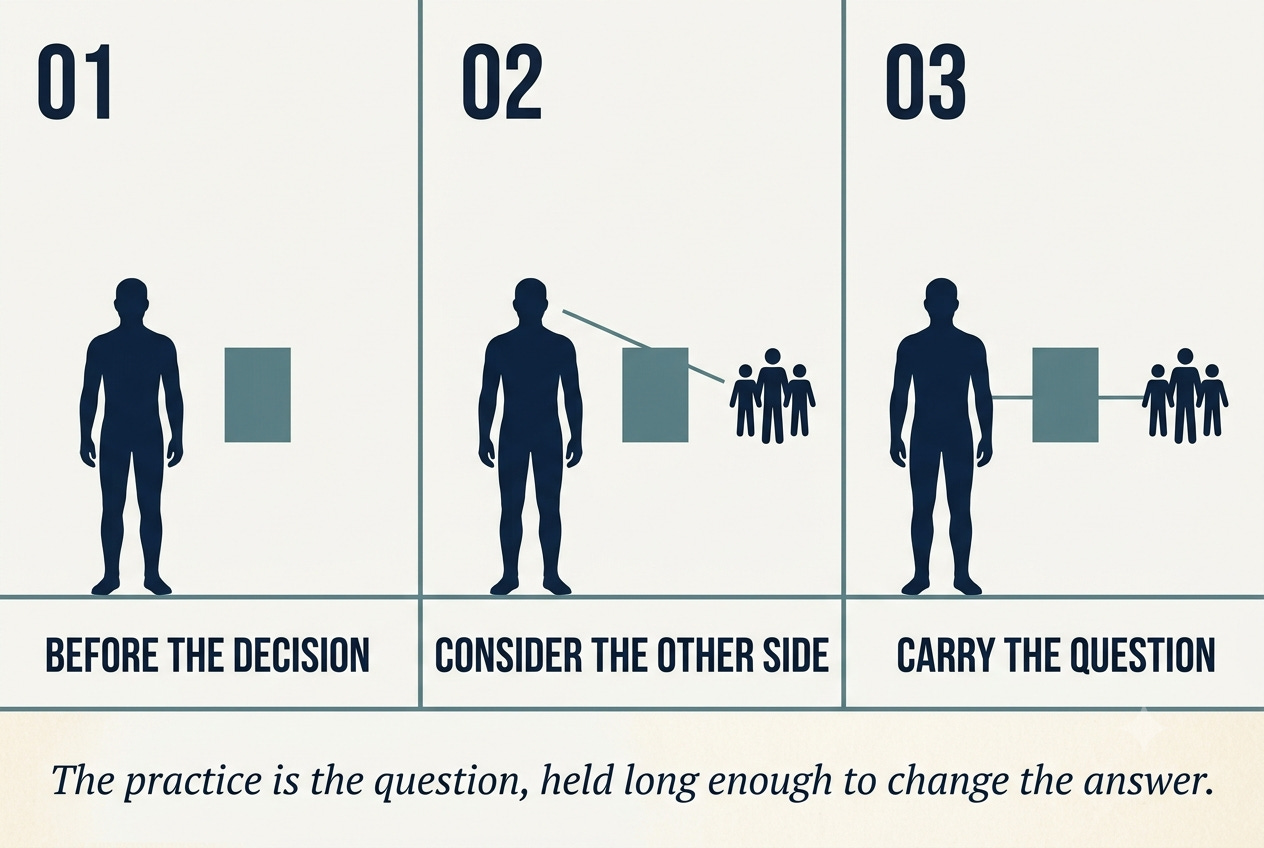
What Love actually requires in the HEAL framework is the capacity to apply a specific question to any significant decision: how will this affect the wellbeing of the people on the other side of it? That question does not veto the decision. It does not override the numbers, the strategy, or the obligation to the organization. It sits next to them as a genuine input rather than a tiebreaker reserved for when everything else is equal.
The discipline is in keeping the question present when the pressure to set it aside is highest: when the board wants decisive action, when the competitive environment rewards the sharp takedown, when the team is watching to see whether you are willing to win. The leaders who practice Love consistently are not the ones who feel it most intensely. They are the ones who have built it into the structure of how they make decisions, so that care does not have to compete with rigor but is already part of what rigor means.
Theory in Practice: what the four do to each other
The individual account of each HEAL element is incomplete. What matters most, and what a single-issue format cannot easily show, is what the four elements do to each other when they operate together, and what emerges when they are held apart.
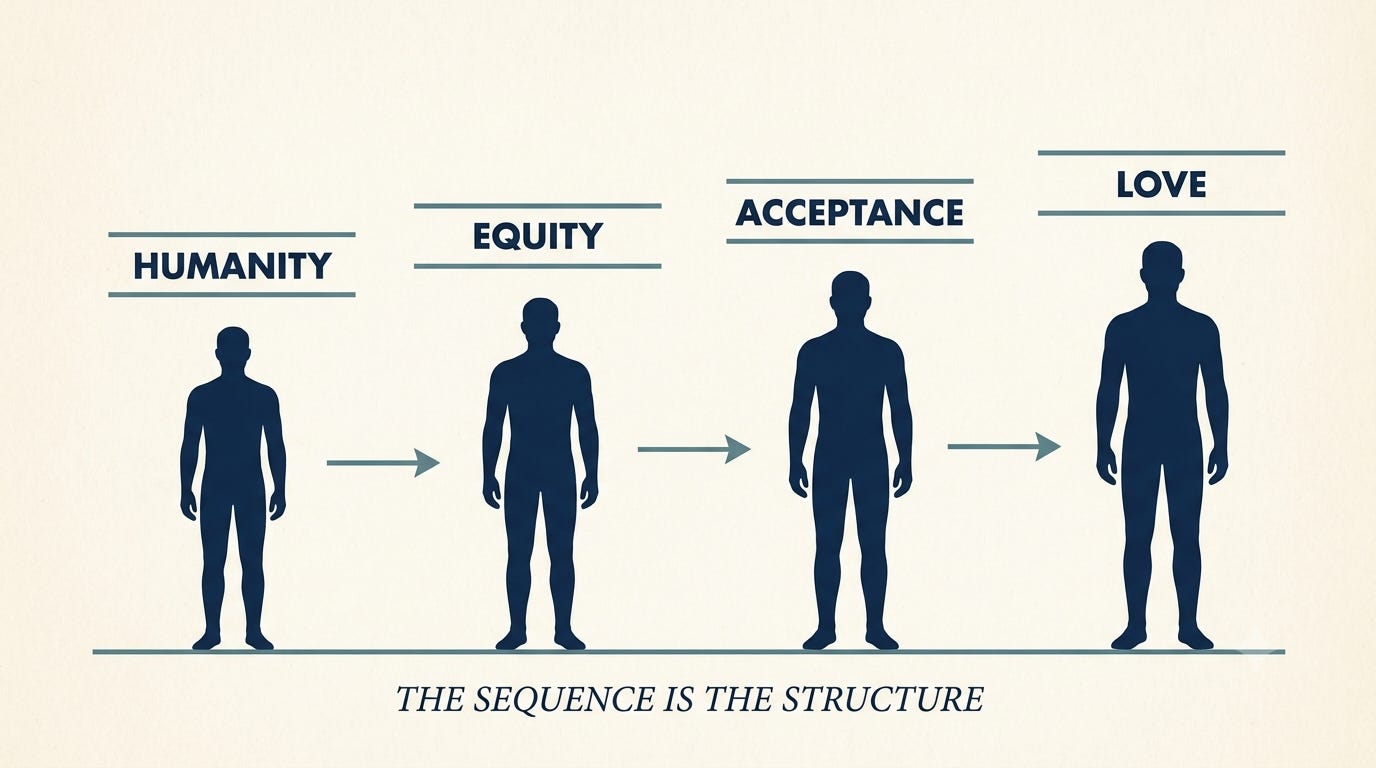
The sequential dependency. HEAL is not a list of parallel practices. It is a sequence, and the sequence has a specific logic. Humanity creates the attentional capacity without which Equity cannot function: you cannot expand the range of what you notice if you have already automated the noticing. Equity expands that attentional capacity across the full range of people and perspectives in the system, creating the conditions under which Acceptance becomes possible: you cannot receive a concern on its own terms if you have already filtered out the people most likely to raise it. Acceptance creates the informational environment in which Love can be practiced effectively: you cannot make decisions that genuinely account for others’ wellbeing if you are only receiving a narrow band of information about what their wellbeing actually looks like. And Love, practiced with discipline rather than sentiment, provides the motivation to keep practicing the first three even when they are costly.
Remove any link in this chain and the downstream elements are quietly undermined. This is why the framework presents as a posture rather than a checklist. You cannot practice the later elements well while skipping the earlier ones.
The aggregate effect. At the team level, a leader practicing all four HEAL elements in sequence produces a specific kind of information environment. More signal reaches the leader. A wider range of perspectives survives long enough to influence decisions. Concerns are raised earlier, when they are still actionable, rather than suppressed until they become crises. The team’s collective intelligence, which is always larger than any individual’s including the leader’s, is more fully available to the decisions that need it.
This is not a soft outcome. Research on team decision quality consistently finds that the quality of decisions made by groups is strongly predicted by the quality of information that actually enters the decision process, not the quality of the individuals involved and not the sophistication of the analytical framework applied afterward. A team with a rich, well-functioning information environment and a modest analytical framework will routinely outperform a team with a sophisticated analytical framework and a filtered information environment. HEAL is, among other things, a theory of how to build the first kind of team.
The disaggregate effect. At the individual level, the effects of HEAL, and its absence, are not evenly distributed. This is the dimension most leadership frameworks miss entirely. When a leader’s Humanity is eroding, the people most likely to be affected first are those whose concerns require the most attentional effort to receive: team members who communicate differently, whose problems do not fit standard templates, whose signals are quiet rather than urgent. When a leader’s Equity bandwidth is narrow, the people most filtered out are those whose experience diverges most from the leader’s own. When a leader’s Acceptance is weak, the concerns that fail to survive translation are disproportionately the ones the organization most needs to hear: the early warnings, the heterodox readings, the dissenting assessments.
The pattern compounds. The people most likely to hold signals the leader needs are often the people least likely to have their signals received. This is not because the leader is hostile to those people. It is because the same cognitive shortcuts that make leadership efficient in high-volume environments also create systematic blind spots, and the blind spots are not random. They cluster around difference: differences in communication style, in positional power, in cultural background, and in how closely someone’s experience resembles the leader’s own.
HEAL is a corrective to this pattern. Not a complete solution, since the pattern is deep and the correctives are effortful, but a structured set of practices that, applied consistently, expands the information environment enough to make the blind spots visible before they become consequential.

The failure modes in combination. Most leaders practicing some version of this framework are practicing a partial version, and it is worth naming what the partial versions look like.
Humanity without Equity is attentive leadership that still filters. The leader is genuinely present and genuinely paying attention, but consistently receiving some voices more completely than others. The attention is real. The range is narrow.
Equity without Acceptance is fair-minded leadership that cannot receive an unfamiliar concern. The leader knows, in principle, that different people face different friction. But when someone raises a concern in an unfamiliar register, the leader translates it before responding. The concern was heard. It was not held.
Acceptance without Love is leadership that can hold difference at arm’s length, that creates genuine space for challenge, but that is not changed by it. The leader can receive the dissenting view. They just do not let it cost them anything.
And Love without the first three is sentiment. It is the feeling of caring without the informational foundation that makes caring effective. It is what a board is right to be suspicious of when it shows up without structure: the leader who genuinely cares but does not know what is actually happening to their people, because the practices that would have told them were never built.
What is coming: signals
The next monthly arc turns to a new theme: the signals leaders are exposed to, how some are easily missed, why some are deliberately ignored, and how to manage them effectively.
The connection to HEAL is direct. The framework is, at its core, a theory of signal reception. Humanity determines whether the leader’s attentional capacity is intact enough to notice what is actually there. Equity determines whether the range of signals the leader can receive is wide enough to include the people most likely to carry important information. Acceptance determines whether the signals that arrive can survive the translation process and reach the leader in a form that retains their original meaning. Love determines whether the leader is motivated to act on what they receive, even when acting is costly.
The signals arc will explore what lives in the environment: what is there to be noticed, why some signals are louder than others, what makes a signal easy to dismiss, and what structural and cognitive factors determine whether important signals reach the decisions they are relevant to.
Held next to HEAL, the two arcs form a complete account. What is in the environment. What the leader’s capacity to receive it looks like. Both matter, and failures in either category produce the same result: a leader making decisions on an information set that is smaller than the one available to them.
The month, in practice
One element of HEAL is harder than the other three. Not more conceptually demanding, but harder to actually do in the conditions most leaders work in.
Love, practiced as discipline rather than sentiment, requires holding two things simultaneously that the surrounding culture keeps trying to separate. Care and rigor. Accountability and genuine investment in the person being held accountable. The willingness to disappoint someone and the genuine concern for their wellbeing. These are not opposites, but they feel like opposites under pressure, and the pressure is usually present.
The other three elements have versions of this tension, but Love names it most directly. You can be attentive without being accountable. You can be equitable without being honest about what equity demands. You can accept difference without being changed by it. But you cannot practice Love well, in the disciplined sense the framework requires, without simultaneously holding care and edge in the same hand, and refusing to use either one to escape the difficulty of the other.
The practice for the next four weeks is a single question, applied before any significant decision: how will this decision affect the wellbeing of the people on the other side of it? Not as a veto. Not as a requirement that the answer be comfortable. As a seat at the table it does not always get.
Run it for a month. Notice what it changes. Notice what it makes harder. The places where it makes things harder are usually the places that most needed the question.
Theory Reference
This edition draws on four bodies of research, one for each HEAL element.
Automation bias (Humanity) was first systematically described by Kathleen Mosier and Linda Skitka in 1996 and elaborated through empirical aviation simulation studies in a 1998 journal article. Their core finding is that reliable automated systems produce both commission errors, in which a user follows an incorrect automated recommendation, and omission errors, in which a user fails to notice problems the system does not flag. The pattern has since been replicated across medical decision support, air traffic control, and generative AI contexts. The mechanism is cognitive economy: a high-confidence automated output functions as a signal to stop searching, and the more reliable the system, the stronger that signal becomes. Critically, user expertise and domain knowledge do not reliably protect against the bias.
Ethnocultural empathy and perspective-taking (Equity) come from the Scale of Ethnocultural Empathy (SEE), developed by Wang and colleagues in 2003. The instrument identifies empathic perspective-taking as a distinct and measurable dimension of empathic capacity: the ability to genuinely inhabit another person’s frame without collapsing it into your own. Three validation studies found that leaders with low perspective-taking scores do not consciously reject unfamiliar viewpoints but absorb and translate them, producing engagement that functions as a closed interpretive loop. The SEE has since been validated across multiple cultural contexts.
Prototype theory (Acceptance) originates with Eleanor Rosch’s 1975 paper establishing that human categorization works through graded membership relative to central, representative examples rather than through necessary-and-sufficient conditions. The leadership application is direct: leaders carry implicit prototypes for what a credible concern, a trustworthy signal, and a legitimate complaint look like. Concerns that do not match the prototype closely enough receive less weight and less follow-up, not because they were rejected, but because they required more cognitive work to recognize as important.
Wise empathy (Love) is drawn from a January 2026 article in Harvard Business Review by Nick Hobson and Gregory Depow. Their core claim is that empathy applied without judgment can deplete leaders and still leave team members feeling unseen, because different emotional moments call for different responses. Wise empathy is more selective than general empathy. It distinguishes between moments requiring emotion-sharing and moments requiring compassionate support and clear action, and it holds limits as expressions of care rather than its absence.
Further Reading
Hobson, N., & Depow, G. J. (2026, January 14). How leaders can practice wise empathy. Harvard Business Review. https://hbr.org/2026/01/five-steps-to-identify-the-right-emotional-response-for-each-moment
Mosier, K. L., & Skitka, L. J. (1996). Human decision makers and automated decision aids: Made for each other? In R. Parasuraman & M. Mouloua (Eds.), Automation and human performance: Theory and applications (pp. 201–220). Lawrence Erlbaum Associates.
Mosier, K. L., Skitka, L. J., Heers, S., & Burdick, M. (1998). Automation bias: Decision making and performance in high-tech cockpits. The International Journal of Aviation Psychology, 8(1), 47–63. https://doi.org/10.1207/s15327108ijap0801_3
Rosch, E. (1975). Cognitive representations of semantic categories. Journal of Experimental Psychology: General, 104(3), 192–233. https://doi.org/10.1037/0096-3445.104.3.192
Rosch, E., & Mervis, C. B. (1975). Family resemblances: Studies in the internal structure of categories. Cognitive Psychology, 7(4), 573–605. https://doi.org/10.1016/0010-0285(75)90024-9
Wang, Y.-W., Davidson, M. M., Yakushko, O. F., Savoy, H. B., Tan, J. A., & Bleier, J. K. (2003). The Scale of Ethnocultural Empathy: Development, validation, and reliability. Journal of Counseling Psychology, 50(2), 221–234. https://doi.org/10.1037/0022-0167.50.2.221
Practice of Thinking is the monthly companion to Theory Meets Tuesday from Unified Purpose. Monthly reflections on leadership practice. Replies are read.